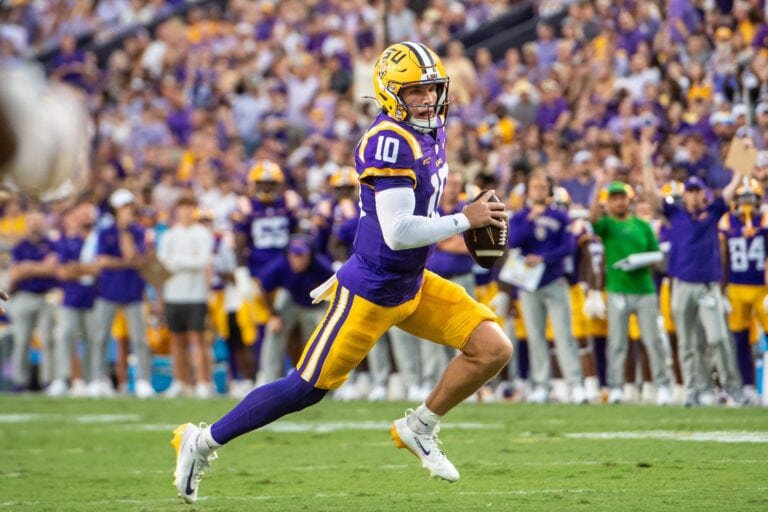
College football doesn’t offer many certainties anymore. One truth has survived every wave of change: Jimmies and Joes still matter more than X’s and O’s. Teams with the best players usually beat teams with the best coaches.
That trend was bucked a year ago with Indiana, but the point still stands. One of the best examples of this has been the blue chip ratio metric and theory. The concept is simple, it’s a percentage of blue chip recruit players for each team. The higher the ratio, the better odds for a team to win the national championship. It’s not and exac science, but it’s pretty close.
From 2011 to 2024 every single national champion had over a 50 percent blue chip ratio. Every single one. Only three of those 15 teams had under 61 percent. That trend was about as fail proof as you could imagine, until Indiana last season.
The Hoosiers won with an absurd eight percent. So, it might not be mandatory to win it all, but it can’t hurt. Here’s a look at every SEC team’s blue chip ratio for the 2026 season.
2026 SEC Blue Chip Ratio
1. Georgia – 68.6 percent
2. Texas A&M – 67.4 percent
3. Alabama – 60.7 percent
4. LSU – 59.3 percent
5. Texas – 58.1 percent
6. Florida – 56.8 percent
7. Ole Miss – 51.8 percent
8. South Carolina – 48.2 percent
9. Oklahoma – 45.7 percent
10. Tennessee – 42.9 percent
11. Missouri – 34.8 percent
12. Mississippi State – 32.9 percent
13. Auburn – 31.4 percent
14. Kentucky – 31.3 percent
15. Arkansas – 24.0 percent
16. Vanderbilt – 17.7 percent
Takeaways
With the transfer portal becoming more and more prominent, having a high blue chip ratio is not as imperative anymore to hoist a trophy at the end of the season. It’s a flawed system in a lot of ways considering it strictly accounts for rankings out of high school and not the transfer portal. That seems especially dumb considering how important acquiring talent out of the transfer portal has become to all teams across college football.
As far as the SEC, there are a lot of interesting takeaways to look at this season. First, the decline of overall talent from most teams, but several elite teams specifically, is wild to see.
You’d expect there to be a drop off at Alabama after Nick Saban retired. But, to see their number dwindle from 90 percent in 2023 to 60.7 percent this season is shocking.
Georgia is another team that has done exceptionally well at only recruiting elite talent, but retaining it and keeping it out of the portal, and their number dropped below 70 percent for the first time since before COVID.
Then, there’s Auburn, who may be the most intriguing team of all. Their number sits at 31 percent. That is roughly cut in half from the previous season when they were at 60 percent, which was good enough for 13th in the country. They did nothing but underperform with that roster. This year, they have a new coach and a boatload of transfers from the G6 level.
Maybe the story of having the most Jimmies and Joes won’t change. What may change, however, is the obvious inaccuracy of how well those kids may develop once leaving the high school ranks. No team better represents that notion than last year’s Indiana.