LSU did far more than conduct a routine walkthrough one week before its season opener against Clemson.
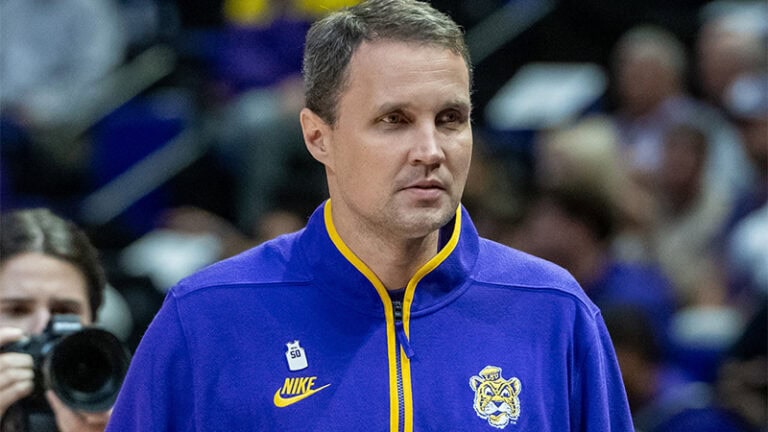
Lane Kiffin and the Tigers staged a complete game-day rehearsal Saturday in Tiger Stadium. The roads were blocked, the barricades were up and the temporary security staff was in place. The cheerleaders, football team and Golden Band from Tigerland followed their normal procession down Victory Hill before entering the stadium.
Once inside, LSU recreated nearly every detail of a Saturday night in Death Valley. The Tigers wore their game uniforms, while the third and fourth-team players dressed in orange and white and used the visiting locker room to simulate Clemson.
The band performed its pregame routine and played throughout the scrimmage. The public-address announcer called every play, the officials used live microphones and LSU incorporated the scoreboard videos, fireworks, cannon and even a flyover during the national anthem.
Then, according to multiple sources, LSU played an actual game.
The first and second-team Tigers defeated the scout-team version of Clemson, 86-18.
Here’s what we heard from LSU’s final mock game before the season opener.
KIFFIN REPLICATES GAME DAY
The most notable takeaway may have been the extraordinary attention to detail.
LSU did not simply practice situational football or move quickly through a scripted walkthrough. The Tigers recreated the entire experience, beginning with the procession down Victory Hill and continuing through the final whistle.
The scout team wore Clemson’s colors, operated from the visiting locker room and ran the schemes LSU expects to see Saturday. Even the coaches working with that group wore orange.
The exercise was designed to eliminate as many surprises as possible for a roster featuring dozens of newcomers. Players, who have never experienced an LSU home game, now know what the walk down Victory Hill, pregame ceremony and atmosphere inside Tiger Stadium will feel like.
It was another example of Kiffin’s obsession with finding small advantages around the margins.
LEAVITT TAKES COMMAND
Sam Leavitt continued his strong finish to fall camp.
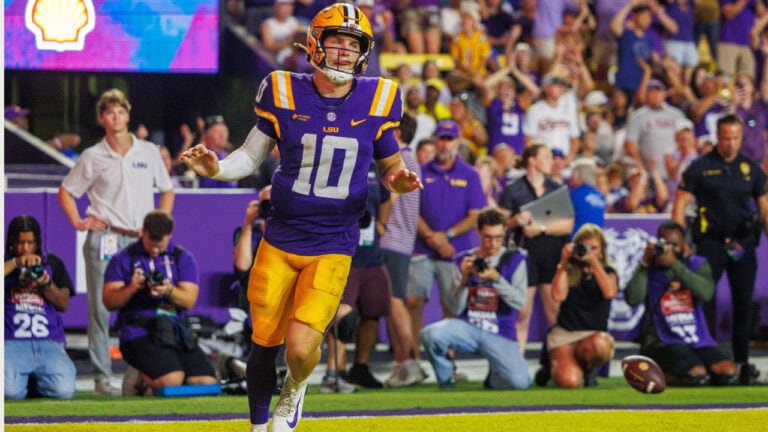
On LSU’s opening possession, Leavitt connected with Florida transfer Tre’ Wilson on a go route down the right sideline. The throw hit Wilson in stride, and the explosive receiver turned it into a long touchdown.
Leavitt also missed Jayce Brown on another deep ball that likely would have produced a score. Overall, however, the Arizona State transfer reportedly played well and continued using his mobility to extend plays.
The most encouraging development may have been his leadership.
At one point, the offense was forced to waste a timeout. Leavitt responded vocally and challenged his teammates. That is noteworthy after he spent the spring recovering from foot surgery and was unable to establish himself fully as the offense’s on-field leader.
With the opener approaching, Leavitt now appears comfortable taking ownership of the unit.
DILIN JONES LEADS THE BACKFIELD
Dilin Jones left little doubt about his place atop LSU’s running back rotation.
Jones broke two runs of more than 30 yards during the first half. One was erased by a holding penalty, while the other set up one of his two short touchdown runs.
Caden Durham produced several explosive runs during the previous scrimmage, but Jones remains LSU’s No. 1 running back entering the Clemson game.
Sophomore Harlem Berry also reportedly had an impressive performance. LSU should still rotate multiple backs, but Jones appears positioned to receive the first opportunity and the largest workload.
WILSON PROVIDES EXPLOSIVENESS
Wilson appears ready to play a significant role in LSU’s offense.
The Florida transfer scored the first touchdown of the scrimmage and has consistently demonstrated a different gear from the other receivers in the room. Wilson is not LSU’s biggest target, but his suddenness and acceleration give the Tigers a legitimate big-play threat.
Wilson, Jackson Harris, Winnie Watkins and Malik Elzy appear to have separated themselves as LSU’s primary group. Brown remains involved as the next receiver in the rotation.
Elzy has been one of the biggest risers of fall camp. His size gives LSU a different type of target from the smaller, quicker receivers surrounding him.
DEFENSIVE LINE ROTATION EMERGES
LSU opened with Princewill Umanmielen, Deuce Geralds, Dominick McKinley and Dylan Carpenter along the defensive front.
That could be the starting group against Clemson, although LSU rotated heavily throughout the mock game. Jordan Ross, Richard Anderson and Malik Blocton were among the players who received work with the top unit.
The Tigers appear committed to using a deep rotation regardless of which four players are announced as starters.
Lamar Brown was dressed and participated in the procession down Victory Hill, but he did not play. Brown was rolled up during a previous practice and also missed the prior scrimmage. Holding him out appears to have been precautionary with the opener less than a week away.
Junior Tuihalamaka was also present but did not participate.
DEFENSE CREATES TURNOVERS
Umanmielen made one of the most impressive defensive plays of the game.
The veteran edge defender dropped into coverage, baited the quarterback and stepped into the passing lane for an interception. His athleticism gives defensive coordinator Blake Baker another option when disguising pressures and coverages.
Dashawn Spears also recorded an interception and produced a long return.
Spears is listed as LSU’s starting STAR, the hybrid safety-linebacker position in Baker’s defense. His combination of coverage ability, physicality and open-field athleticism could make him the ideal player for that role.
Whit Weeks was also described as a tackling machine, while Jordan Seaton delivered a pancake block during LSU’s opening offensive series.
SAFETY ROTATION CONTINUES
Tamarcus Cooley was announced as the starting safety alongside Ty Benefield, but LSU continued rotating four players at the position.
Benefield, Cooley, Jhase Thomas and Faheem Delane all received significant work.
Benefield appears unlikely to leave the field often when healthy, but the Tigers should find roles for all four safeties. Spears will operate separately at STAR and spend more time aligned near the box.
OFFENSE LOOKS COMPLETELY DIFFERENT
One source described LSU’s offense as the polar opposite of the unit the Tigers fielded last season.
That is not necessarily a criticism of Garrett Nussmeier. Leavitt is simply a very different quarterback, and Kiffin’s system is designed to take advantage of his mobility.
LSU will play quickly, simplify the quarterback’s responsibilities and use helmet communication to provide Leavitt with information before the snap. Because the Tigers often snap the ball before the play clock reaches 15 seconds, Kiffin and offensive coordinator Charlie Weis Jr. can remain in Leavitt’s ear for nearly the entire pre-snap process.
That structure should help a portal-heavy roster operate efficiently despite having limited time together.
STARZYK STAYS PERFECT
Kicker Scott Starzyk converted every field-goal attempt during the mock game.
The Arkansas transfer has demonstrated a massive leg throughout fall camp and now appears ready to handle LSU’s place-kicking duties.
Combined with the encouraging reports from the offense and defense, Starzyk’s performance helped LSU complete a productive—and extraordinarily detailed—final rehearsal.
The walkthroughs are finished. Game week has arrived.