Change is the only constant in college football.
Every season brings a new roster. Most bring adjustments on the coaching staff. From January through August, teams are assembled and systems are installed. At LSU, the changes have been drastic from 2025 to 2026 with a new head coach and more than 50 incoming players.
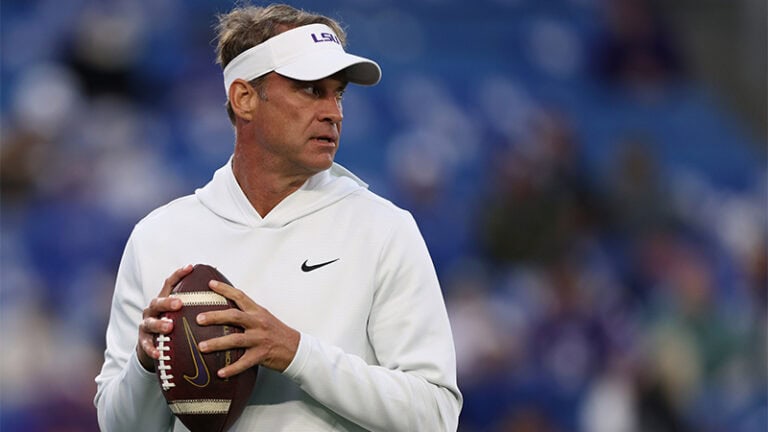
Head Coach Lane Kiffin and offensive coordinator Charlie Weis Jr. have been tasked with solving a broken LSU offense. That side of the ball has been overhauled in terms of coaching and personnel with only four returning starters and a new staff.
The most important of the newcomers is quarterback Sam Leavitt. The biggest question mark surrounding the new signal caller is not ability – he led Arizona State to the College Football Playoff two seasons ago – it’s his health recovering from Lisfranc surgery and his ability to pick up the offense with limited reps over the spring.
Asked if he was physically ready to use his athleticism after a spring on the sideline and a summer behind closed doors, Leavitt cracked a wry smile.
“I haven’t played a game yet, so we’ll see,” Leavitt said Tuesday. “I feel 100%. I’m ready to just be a be a great player for this team and do everything that they need to win games. So, yeah, I feel like I’m going to be the same player physically and then every aspect mentally I’ve just gotten better.”
Leavitt used LSU’s virtual reality equipment to take mental reps during the spring. He’s put in long hours over the summer and into fall camp with his teammates. One of the few bright spots for LSU offensively last year was tight end Trey’Dez Green who set LSU’s tight ends receiving touchdowns record with seven.
Leavitt quickly took the time to get up to speed with his most dangerous weapon.
“I feel like, with me and Sam, I feel like it just grows every day,” Green said. “I just feel more comfortable with him every day. We’re working on throws. We’re working on getting our timing down. It’s just been amazing.”
The Kiffin-Weis offense relies on quick communication and executing route combinations. Wide receivers, tight ends and the quarterback have to read defenses and adjust on the fly.
Because Leavitt missed time in the spring, his functional time in the offense was limited. That forced a big time game of catch up.
Throws on an empty field in Dallas in July or on The Ponderosa in August are one thing. Dialing things up against Clemson’s defense in front of 102,000 and a national television audience is quite another.
Leavitt can draw on past experience to handle his emotions in the moment.
“I think I take it back to going and playing in the (CFP) playoffs and just how exciting that moment was,” Leavitt said. “I’m just going to really embrace the moment for a little bit because you’re not going to get many opportunities to play in Tiger Stadium on gameday. So, it’s going to be special.”
But will the play meet the moment?
Kiffin has praised Leavitt’s work and performance multiple times during fall camp. He’s also added that he rarely shares that with the media. It could be a sign of what’s to come, and it could be a tool to encourage a new quarterback. Time will tell.
Green feels that a lot of work has been done in a short amount of time.
“There’s not a time that he’s thinking something that I’m not on the same page with him, and we don’t even have to say anything to each other,” Green said. “So, I just feel like that chemistry is there, and it’s going to be exciting and fun. He’s a wonderful player, wonderful leader, and I’m just happy to call him my quarterback.”