
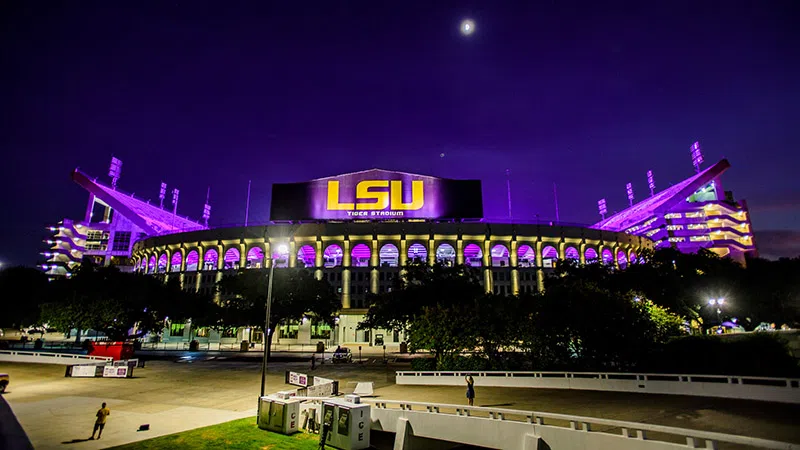
Chris Parent/LSU Athletics
By Hunt Palmer
So many new aspects of college athletics seem silly to me.
Stanford and Cal joining the Atlantic Coast Conference is humorous. Trinidad Chambliss’s eligibility lawsuit being ruled on in a one-stoplight Mississippi town made me chuckle. So did Charles Bediako coming back two years removed from leaving his college eligibility for NBA dreams.
Nothing surprises me anymore.
So, I’m not at all shaken by Mississippi attempting to follow Arkansas by giving tax breaks to college athletes.
He scored 26 per game on the AAU circuit? Tax free earnings in Bud Walton! His Pro Football Focus pass blocking grade at Louisville was 88.8? He’s in the portal? Tax free in The ‘Sip!
Of course, everyone else in those states is on the hook to pay their fair share of income taxes. The high school guidance counselor who makes a fraction of the transfer edge rusher needs to pony up, but the small forward coming off the bench is exempt, too.
It’s an absurdity, but it’s not surprising in the least.
Collegiate athletics burst through the NIL door with no plan, no enforceable restrictions and no clue. It’s been a circus for half a decade now. To be clear, I have no problem at all with student-athletes making money. My fascination is with the adults who are chasing their tails to try to figure out how to make it all work for them.
This entire set of circumstances is driven by the almighty dollar. And that dollar comes from the fans. The fans watch on television so the media corporations can charge the advertisers. They buy the tickets. They fill the seats.
What happens if the fans become disenchanted?
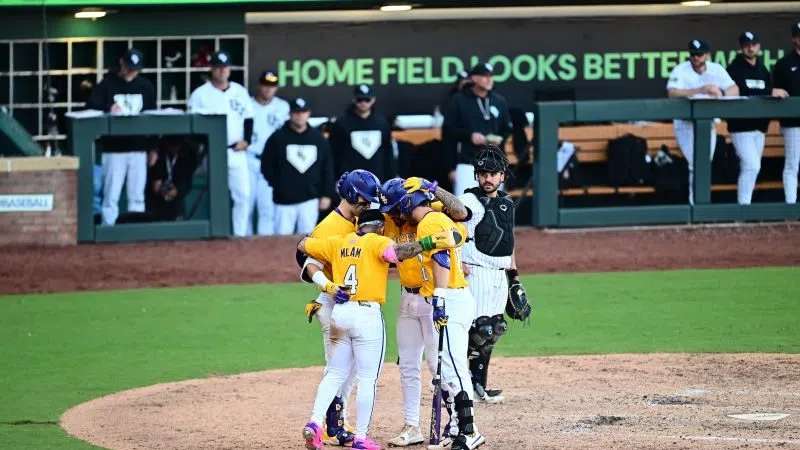
You couldn’t pry my dad’s LSU football tickets out of his hands with a SWAT team. I showed up to the Sugar Bowl this year and had an absolute ball. At no point did I consider how much the quarterbacks made, which players were transfers or who paid the NIL money to the athletes legally or illegally. I shook a thousand hands in Omaha last summer. No one cared about Anthony Eyanson’s stay in Baton Rouge being 10 months instead of four years.
There is certainly a faction you can’t lose, myself included. I’d be in whether it was my job or not.
However, professional baseball ruled this country’s sports scene for decades. America’s Pastime was indestructible. Or so we thought. The players and owners got sideways over money in the early 90s, and the sport was on life support as football blew by it in popularity. That gap has only grown.
Average Joe didn’t like millionaires arguing with millionaires about millions. Major League Baseball is about to do that whole song and dance again next winter, and many question how much damage will be done to the league’s reputation.
Collegiate athletics felt insulated from that type of situation forever. Alumni are bound to their schools for life and will always come back to that campus to see old friends and cheer on Old State U. The players played for pride, not contracts (at least not ones signed on top of the table, wink wink).
Those days are long gone.
Some don’t like the idea of the players getting paid. Others don’t like the idea of players transferring four times in four years. Schools are suing quarterbacks. Players are making more, in some instances, than coaches. They’re opting out of games and “load managing” to protect draft stock.
Any objection a fan has to all of that is just preference, but it’s stacking up.
Now you’re telling everyone they owe taxes for their income selling medical equipment, teaching school, balancing books or working security while the 19-year-old backup who was a five-star recruit doesn’t owe the state a cent on that $1.5 million.
That won’t sit well.
When you look at Louisiana’s 2025 budget, exempting all the NIL dollars across the state, not just at LSU, would have cost the state $510,000 of the $44.6 billion budget. That’s roughly 1.1%. In the grand scheme, that’s insignificant, but to most it’s half a million dollars that could be used to help a state that ranks close to fiftieth in plenty of categories. Take your pick.
Put the other way, if LSU pays a transfer football player $3,000,000, he’s saving $90,000 in state taxes. Could that be the selling point? It sure could be if you’re battling USC for the player and he’s got to pay $400,000 on that $3,000,000.
Professional organizations have fought this battle for decades. Now it’s trickled down to the collegiate ranks. SEC states Texas, Florida and Tennessee don’t have state income tax. LSU rostered 18 scholarship players from those states last football season.
The argument could be made that losing out on $500,000 in NIL taxes could be easily offset with an 11-1 football season that allows the south Louisiana economy to boom on those weekends.
I got my economics degree the same place I got my law and medical degrees, so I’ll leave that to the powers that be.
My career does depend on the passion of college sports fans. And I don’t think they’re going anywhere whether or not Louisiana decides to tax NIL dollars. To this point, that idea hasn’t even gotten to committee. It’s one thing for the entire state to be exempt from taxation. It’s quite another to tax literally everyone else and let the young millionaires off the hook.
I just wonder if the never ending and often ridiculous chase to get college kids paid is going to run its course with big boosters and/or the average fan.
My gut tells me no, but my eyes and ears tell me we just keep taking steps, however small, in that direction.


More Top Stories