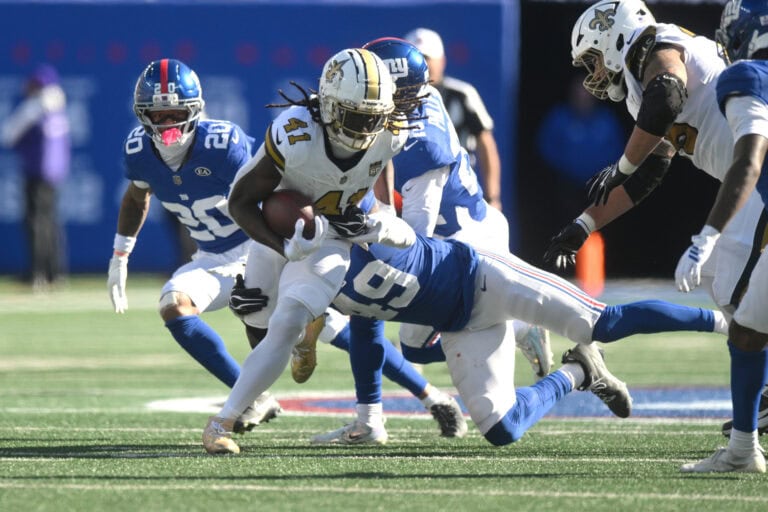
As the New Orleans Saints continue their negotiations for wide receiver Chris Olave’s expected contract extension, there have been a few moves made across the NFL that could have shifted the conversation.
It seems logical that Olave’s camp would be pushing for their receiver to top the recent extension handed to Atlanta Falcons wide receiver Drake London. Atlanta signed London to a four-year extension worth approximately $35.3 million per year with only 37.5 percent fully guaranteed.
While Olave trails London in the major receiving categories, receptions, receiving yards and receiving touchdowns, Olave’s per-game stats each measure up to or surpass London’s weekly production.
Olave vs. London
| Player | Games | Rec. | Yards | Rec. TDs | Rec/G | Yards/G | TDs/G |
| Olave | 55 | 291 | 3,728 | 19 | 5.3 | 67.8 | 0.35 |
| London | 62 | 309 | 3,961 | 22 | 5.0 | 63.9 | 0.36 |
In Olave’s corner is also his 2026 Second-Team All-Pro nod and the fact that he has three 1,000-yard receiving seasons to London’s one. While Olave tied his career-high in game appearances in 2026 (16, the same as 2023), London just put up his career-low with only 12.
However, the Saints are likely to aim lower.
Olave’s draft classmate and former college teammate Garrett Wilson signed a four-year extension with the New York Jets averaging $32.5 million annually and only 29.5 percent of it was fully guaranteed.
It appears likely that New Orleans would try to push closer to that rate. The complicating factor there will be the timing of the deal. Wilson signed that deal a year ago. Since then, London has signed and the Seattle Seahawks and wide receiver Jaxon Smith-Njigba, another of Olave’s college teammates, has reset the wide receiver market.
At the time that Wilson signed his extension, the top deal at wide receiver belonged to Cincinnati Bengals wideout Ja’Marr Chase. Wilson’s $130 million agreement was 80.7 percent of Chase’s $161 million. Smith-Njigba now sits atop the market with his $168.6 million total figure.
At 80.7 percent of Smith-Njigba’s contract, that deal would come out to roughly $136 million, totaling just north of $34 million per year.
Such an average would put Olave just above Dallas Cowboys receiver Ceedee Lamb at the No. 5 highest-paid wideout in the league.
But if New Orleans isn’t as preoccupied with the simple figure of average annual value, of which a player rarely earns 100 percent, then guarantees could be the deciding factor of the deal.
With Olave’s history of head injuries, it makes sense that the Saints would want to protect themselves. Giving up a larger amount per year doesn’t mean much without guarantees. That’s an angle the Saints could play to in order to give Olave the money that would make him a top-paid wideout while still protecting themselves in case of injury.
For instance, New Orleans could indeed give Olave enough to surpass London’s deal. If they gave Olave $35.5 million per year for four years, he’d enter the 2026 season as the league’s third-highest paid wideout. But, if they guaranteed only 30% of his contract, his $42.6 million in fully guaranteed funds would rank No. 16 at the position across the league.
The team could then give additional non-injury guarantees in order to raise his total percentage promised while remaining cautious for injury purposes.
Down the line, additional money could then be guaranteed by restructures, which would open up salary cap space for the team in the year of the adjustment. There could also be roster bonuses built in that allow future guarantees to kick in at designated times throughout the life of the contract.
That means a four-year, $142 million deal ($35.5 million per year) could be very doable for the club without hamstringing itself if an injury were to take place. Fully guaranteeing $42.6 million with total guarantees up to $90 million could be enough to drive the deal home.
This means a total contract value between $136 million and $142 million appears likely based on recent agreements at the position. The sliding scale between the floor and ceiling could be attached to injury guarantees. The more promised despite injury, the lower the overall amount. The higher the overall value, the lower the fully guaranteed funds.