We’re herded cattle during football practice.
Music blares from the elevated speaker system. The sliding door opens, and the media is ushered in to start scribbling notes frantically until we’re told to get out.
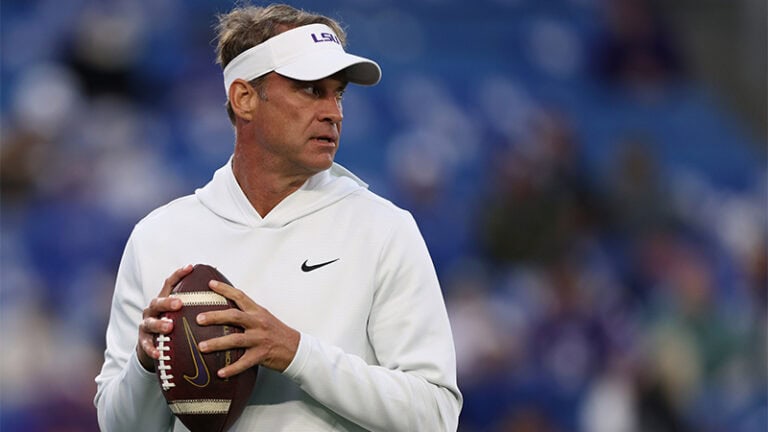
Lane Kiffin is the fifth head coach I’ve covered at LSU, and all of them have a different preference as to where we stand to watch practice. The other variable is where the position groups head for individual drills. Under Kiffin, the running backs come right to us. Kevin Smith barks orders, and we stand 10 feet away. Meanwhile, we’d need an Uber to get to the offensive line.
That gives us a better perspective on running backs than any position on the team.
As spring carried on, it became more evident that Dilin Jones was making a move. He was working with the first team often in 11-on-11. He was first through some of the individual drills. At a spot on the roster that actually features plenty of returning production, Jones was breaking through.
Caden Durham has led LSU in rushing the last two seasons. Harlem Berry got 104 carries as a freshman. Both will factor into this new look rushing attach in 2026. So will Jones. What stands out about the Wisconsin transfer is his size. He’s 25 pounds heavier than Berry and three inches taller than Durham.
Then you consider his background. He was a four-star recruit in the Class of 2024. Both ESPN and 247sports ranked him in the top 10 nationally at his position, and Florida, Auburn, Penn State and Michigan offered. He was Wisconsin’s starting tailback last season before turf toe cost him the second half of the year.
Jones is hardly some diamond in the rough.
Now, you pair him with Lane Kiffin whose offense runs the ball as effectively as almost any coach in the country. Ole Miss ran for 41 touchdowns last year. Only North Texas ran for more. In 2023, the Rebels were 12th in the country in rushing attempts per game. Quinshon Judkins and Kewan Lacy have starred in Oxford. They’re both 5-foot-11 like Jones and between 205 and 215 like Jones.
There isn’t a ton of tape on Jones. He played in three games as a true freshman and then was injured after seven games a season ago. What stands out in limited action is the downhill nature he runs with. It’s a lot of one-cut attempts without much shake-and-bake. That’s ideal for a bigger back.
He has not been used in the passing game. Nine catches for 21 yards is a stunningly low yards per catch average (2.3 ypc). Berry and Durham are probably more adept in that department. Still, if I had to wager on LSU’s starter in the backfield against Clemson, I’d take Jones.
I think LSU is going to split carries between those three backs, and I think Jones is going to lead the team in rushing. I don’t think he’s going to emerge as a star like Lacy did, though. Berry and Durham deserve touches. This feels like the 2007 and 2011 teams in the sense that both of those teams used running back rotations instead of a bellcow. Jacob Hester, Charles Scott, Keiland Williams and Trindon Holliday split reps in 2007. In 2011, it was Spencer Ware, Michael Ford, Kenny Hilliard and Alfred Blue. Jeremy Hill, Leonard Fournette, Derrius Guice and Clyde Edwards-Helaire dominated backfields after that. This won’t look like that.
When the dust settles on the season, I think Jones runs for more than 700 yards and six or eight touchdowns. I think he’ll show the ability to hit some big plays which LSU and Wisconsin struggled to produce last year. Only two teams in America had less 20-plus yard runs than the Badgers last year. Ole Miss produced 19. Wisconsin had six.
Jones may not have been a high-profile transfer in the moment, but expect him to be among the most impactful this fall.