With LSU football retiring the jersey No. 7 of Bert Jones on November 14, 2026, LouisianaSports.net is publishing a series about Jones called 7-on-7 … one story each day for seven days leading up to the jersey retirement ceremony.
The series is written by Pulitzer Prize winner Jeffrey Marx, author of six books including Walking with Tigers: A Collection of LSU Sports Stories.
For a generation of young LSU football fans, All-American Patrick Peterson has been labeled and lauded as “the original No. 7” in an ever-growing line of prominent Tigers to wear the honorary jersey.
Starting in 2008, No. 7 went from Peterson to Tyrann Mathieu to Leonard Fournette and so on. A tradition was born. And the head coach now assigns No. 7 to a big-time playmaker who is both a relentless competitor and a leader by example.
Long ago, though, Bert Jones was actually the original No. 7. He literally wore the number into existence at LSU. Then he took it for a magical ride on the national stage of college football.
More than half a century later, the spotlight is returning. With LSU soon to retire Bert’s jersey – on November 14 – his No. 7 will be permanently displayed on the façade in the south end zone of Tiger Stadium.
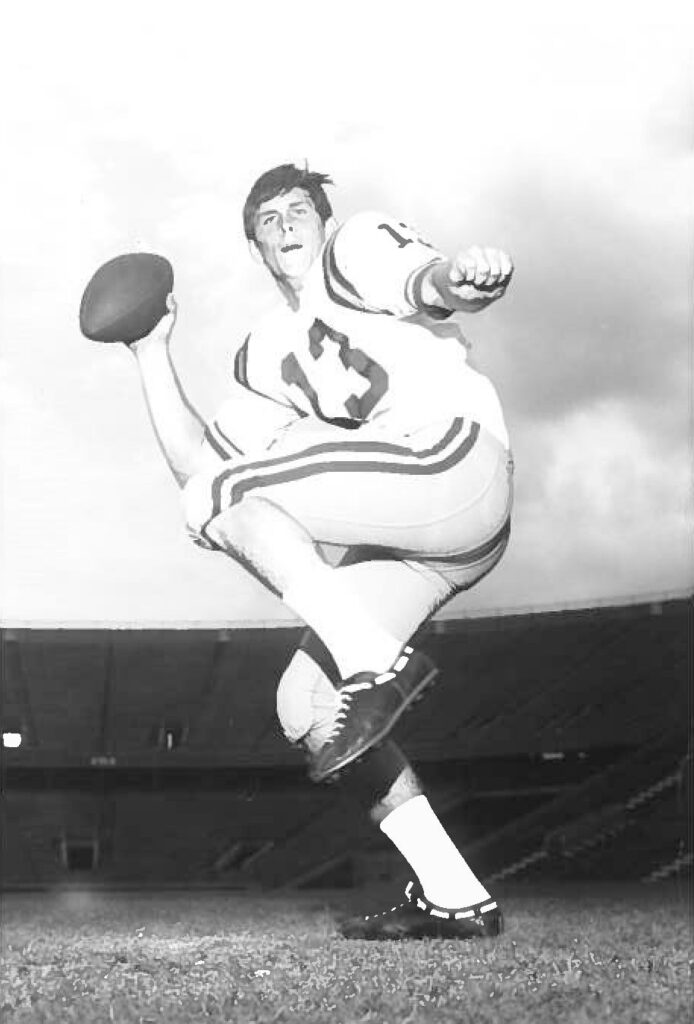
The number will not only represent the record-breaking career of the school’s first All-American quarterback (the only one until Joe Burrow in 2019). It will also carry an intriguing origin story featuring longtime LSU coach Charles McClendon.
The story begins in 1969. It was the year of Woodstock. Neil Armstrong became the first man to walk on the moon. And first-year college students were not yet allowed to play varsity sports. Bert Jones, a big kid with a big arm and big plans to eventually showcase it in the NFL, wore No. 13 for LSU’s freshman football team.
He chose the number – same one he wore in high school for the Ruston (Louisiana) Bearcats – because he had a personal attachment to it. One of his favorite professional players, Pro Bowl quarterback Frank Ryan of the NFL champion Cleveland Browns, wore No. 13. And Bert was not some random faraway fan. He actually knew Ryan because Bert’s dad was an assistant coach with the Browns.
Teen-aged Bert spent multiple summers as a ballboy in training camps and naturally gravitated toward the quarterbacks. He routinely played catch with Ryan – warming up the star quarterback – before the start of practice.
“I spent a lot of time picking up jocks and dirty uniforms, handing out towels, hauling ice, doing all the usual ballboy jobs in the locker room and on the field,” Bert says. “But the highlight of every day was going out and warming up the quarterbacks.
“Frank Ryan was such a fabulous guy – always kind to me – and I just loved throwing and catching with him. Frank was a dear friend of my father’s. And he was my guy, too.”
All of which made the No. 13 an easy choice for Bert.
He didn’t care that a lot of people viewed the number as unlucky.
Then he learned that his LSU coach was one of them.
McClendon called Bert into his office one day before the start of Bert’s sophomore year. This was unusual for Coach Mac. Bert could not recall many other one-on-one meetings with his head coach.
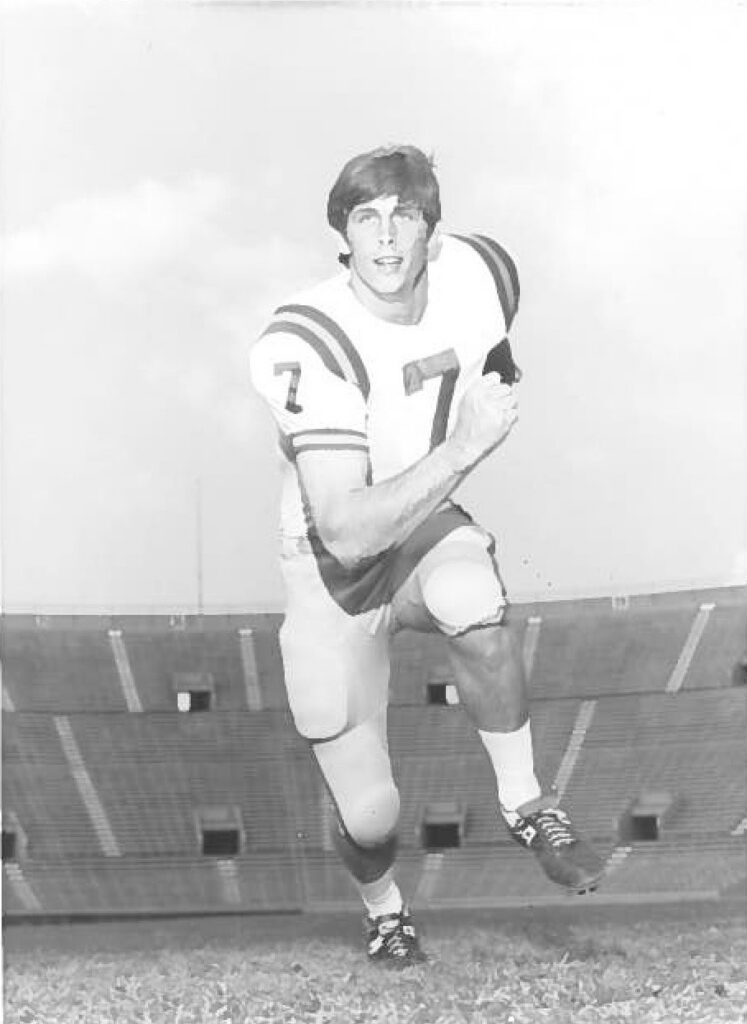
McClendon wanted to talk about uniform numbers.
As Bert recalls it, the conversation was short and simple.
McClendon: “I don’t like 13 because it’s unlucky. How about changing to a different number?”
Bert: “Fine with me.”
McClendon: “How’d you like 7?”
Bert: “OK, 7 it is.”
“Didn’t matter to me,” Bert says now. “I mean, whatever you say. You’re the coach. I’m the player. I was just glad he was thinking about me.”
Bert had no idea why Coach Mac selected 7 for him. The choice had nothing to do with the fact Bert was born on September 7. It had nothing to do with the fact he was one of seven children.
No, the number was apparently just chosen at random.
There was another interesting aspect to the number change. It came as part of the first time LSU ever used any stand-alone single-digit numbers on its football jerseys. (Stand-alone is an important distinction because for one season – 1952 – LSU experimented with an unusual system that placed a single letter next to a single number as identifiers on its jerseys.)
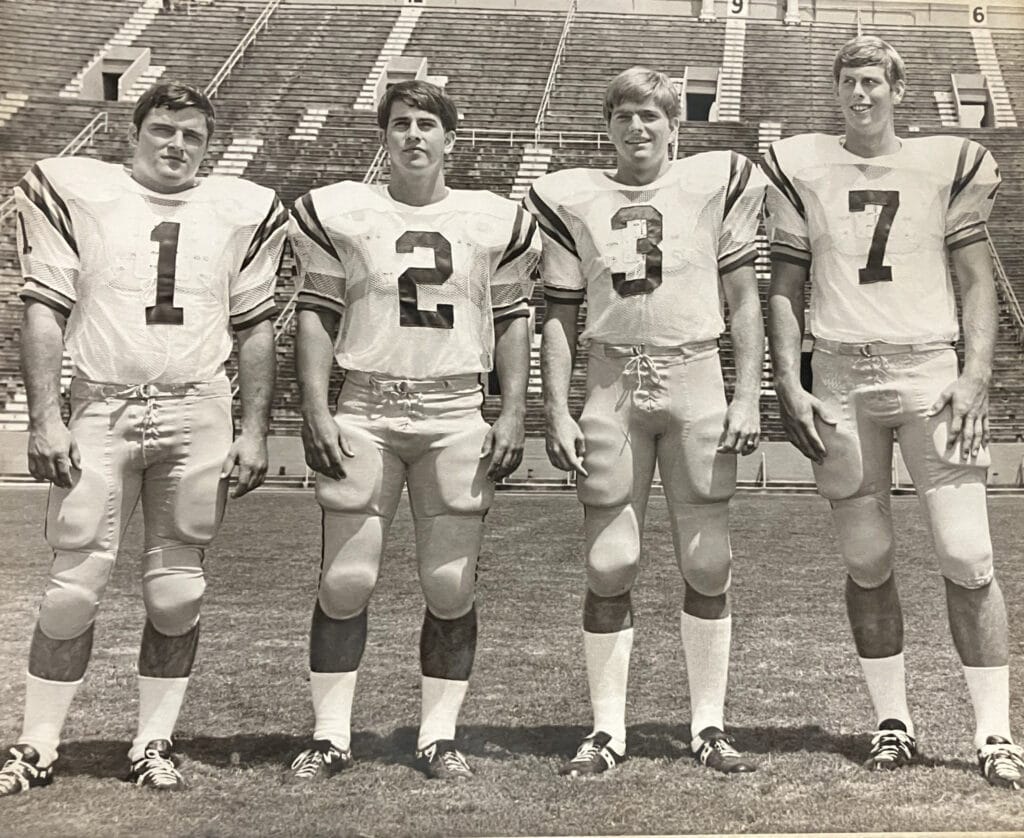
Bert was one of four LSU players to get a single-digit number in 1970. Split end Jimmy LeDoux was given No. 1. Tailback Jim Kadi was assigned No. 2. Split back Al Coffee – a future LSU Hall of Famer for his accomplishments in both football and track and field – was No. 3.
Nobody offered them an explanation for the change to single digits. And none of them questioned it. As LeDoux, now 74 and living in San Antonio, Texas, puts it: “Back then, we just kind of did what we were told.”
LSU clearly thought the novelty of the single-digit numbers was worthy of some attention. On August 31, 1970, someone from the athletic department lined up the four players on the field in Tiger Stadium – numbers 1, 2, 3, and 7, from left to right – for a publicity photo.
Fifty-six years later, that black-and-white photo serves as a history lesson for anyone interested in learning about the real “original No. 7” for LSU football.
Meanwhile, back home in Ruston, 75 years old and still running a lumber business, still most interested in family first, then hunting and fishing before just about anything else, Bert is not thinking about any history lesson related to his jersey number.
He is thinking about the overwhelming sense of gratitude he is feeling: How thankful he is that he got to play LSU football and represent the people of his state in any number. How thankful he is that LSU has now chosen him for what he considers to be the greatest football honor he has ever received.
The No. 7 tradition will continue at LSU – as athletic department rules generally allow for the ongoing use of a number even after a jersey is retired (with Billy Cannon’s not-to-be-worn-again No. 20 being an exception).
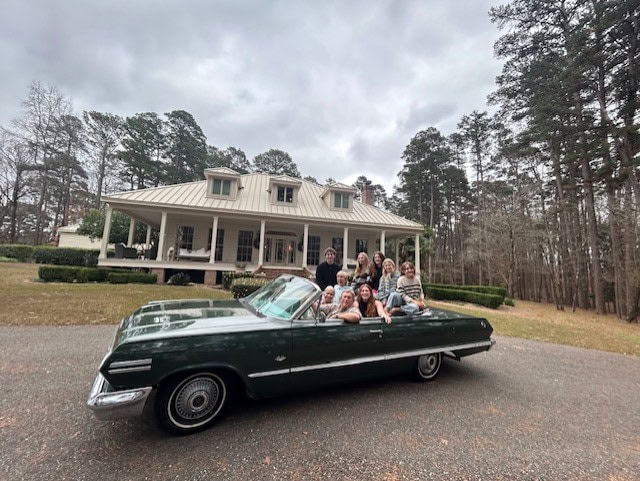
But Bert is much more focused on other number sevens.
He has seven grandchildren. Most of them call him “Big Bert,” a family adaptation of the popular “Big Bird” character on Sesame Street. One of Bert’s favorite photos – taken last year – features all seven grandchildren posed with Bert and wife Danni in his green 1963 Chevy Impala convertible (also considered a family member).
Bert is one of seven residents – along with Danni and five dogs – sharing the old family home on a large lot tucked away in the back of a subdivision. The dogs have lots of space to run and play outside during the day and five small mattresses for inside comfort through the night.
Seven bird feeders hang in the tree just outside the windows by the kitchen table. Bert and Danni love identifying and watching birds – as evidenced by the binoculars sitting on the windowsill atop a book called The Sibley Guide to Birds.
But the number of bird feeders ending up at seven was nothing intentional. It just happened that way. Same way all the other number sevens came into Bert’s life – most notably the one that long ago identified him as an LSU original and will now hang with great distinction in Tiger Stadium.
Previous stories:
Day 1: The Bert Jones I’ve always known: A personal tribute