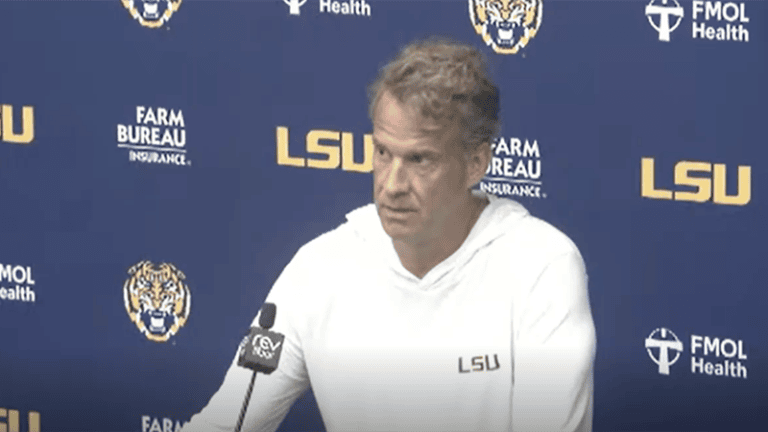
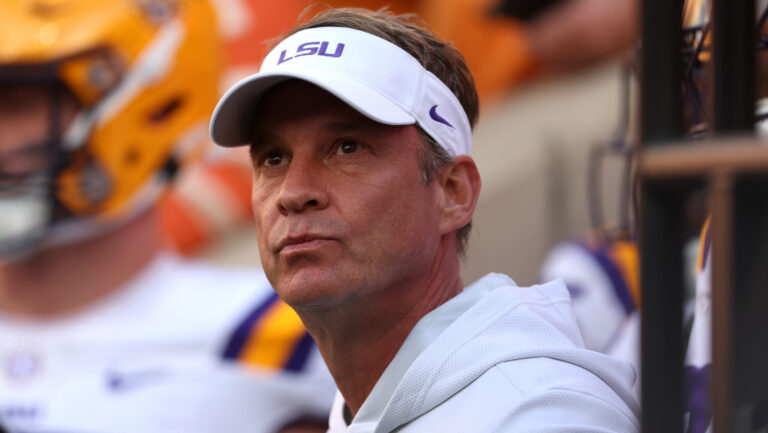
LSU football coach Lane Kiffin is more optimistic about the future of his program than he is about its ability to currently score in the red zone.
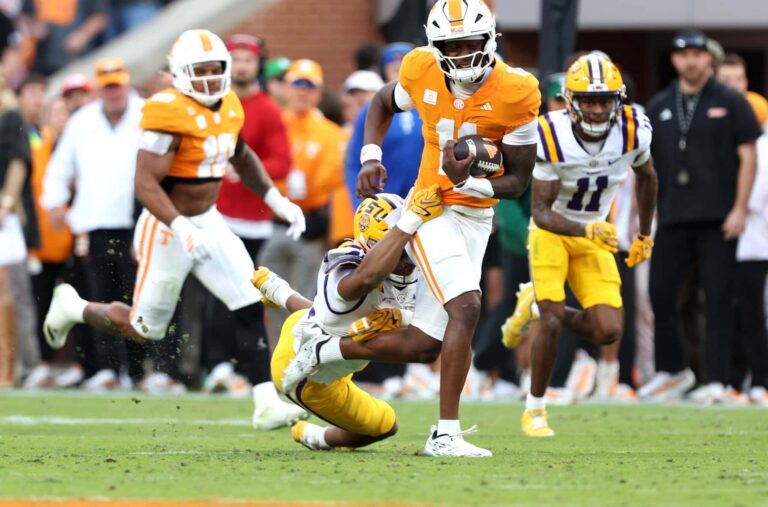
The Tigers dropped their third consecutive game since the bye week, a 27-13 defeat at Tennessee, in a game that closely resembled the previous two.
LSU converted a special teams blunder on Tennessee’s part into a 9-yard touchdown pass from Sam Leavitt to Trey’Dez Green to make it 13-13 with 1:34 showing in the third quarter.
The Volunteers, though, broke the tie on the first of two touchdown runs from quarterback Faizon Brandon with 8:22 remaining in the game. He added a backbreaking 55-yard score with just over four minutes left.
“That’s the common theme will all of the losses, we’re either ahead or tied. We played really well,” Kiffin said during his weekly Monday news conference. “People say what’s the problem with the season? Are you really concerned about the program? I keep saying that I’m not concerned about the future about the program. I’m excited about the future of the program, but we have one core area to fix and that’s how we finish games.
“We’re in these games against really good teams and we don’t play well late, and that can be part of a mindset that we don’t have right,” Kiffin said. “It can be part of a depth thing to fix, so when injuries happen, that you have more depth to play players.”
Kiffin didn’t rank the order in which he and his staff will prioritize the program’s inability to resemble teams at the top of the Southeastern Conference and bound for the College Football Playoff, with head-scratching failures in the final quarter of games.
Improved depth, he said, will allow Kiffin to limit the snap counts of his starters and have capable players ready to rotate earlier into games, so that starters have more energy for the final 15 minutes when games are being decided.
“The accumulation of snaps throughout the season, we play our frontline guys most of them the whole game and that’s showing up late in the game these last three weeks,” Kiffin said. “They rotate more and play more players and are fresh in the fourth quarter. That’s something we’ve got to work on in the offseason. The mindset about finishing games and also putting us in better position with less play counts with more depth.”
LSU (6-5, 3-5 SEC) closes the regular season at Arkansas (4-7, 2-6) at 11:45 a.m. at Razorback Stadium.
The Tigers were limited to a season-low 265 total yards against the Volunteers, with Leavitt completing 27 of 39 passes for 222 yards with no interceptions and one touchdown.
LSU’s offensive line was beaten for eight sacks for minus 46 yards, and the team committed a season-high 16 penalties for 98 yards.
One penalty in particular left Kiffin somewhat miffed about how the rule was applied.
Standout safety Ty Benefield was whistled for targeting against Tennessee’s Da’Saan Brame following an 8-yard completion to LSU’s 16-yard line, where Benefield and TJ Dottery converged on the stop.
Benefield, a Boise State transfer, was flagged for targeting and later ejected following a review of the play, which showed Benefield using the crown of his helmet to hit Brame in the chest.
Tennessee took a 10-6 lead into halftime three plays after the call and Benefield’s ejection. Benefield is eligible to start against Arkansas after missing the second half against the Volunteers.
“I wasn’t critical of the crew,” said Kiffin, referring to the incident that led to his use of profanity during his halftime radio interview, an incident for which he apologized Monday. “I’m critical of the way that the penalty is. The crown of the helmet, when go to the tackle, was used on the body all the time. Obviously, from the neck and head area, it shouldn’t be used because that’s where the injuries happen. For the rule to say you can’t use the crown of your head at any part of the body. That happens all the time. Just watch football. Then in this part, because it was high profile and, in the moment, now all of a sudden that’s targeting.
“It’s not critical of the officials,” Kiffin said. “They’re just doing their job on something that doesn’t make a whole lot of sense and how to coach that. We’re coaching to stay away the head and neck area and to lower the target. That’s really a tough one and really a not good rule that’s applicable to how you play football, and how that decision should be made in a split second of how to tackle somebody.”