Brett Davis-Imagn Images
By Chris Marler
The final CFP Rankings were unveiled Sunday afternoon finalizing this year’s College Football Playoff. There was shock, anger, and confusion. Just like every other time this season the committee tried to explain their thought process and reasoning.
For weeks, Alabama, BYU, and Miami fans pointed fingers and incessantly argued as to which team was most deserving of the assumed final spot in the field. In the end, Notre Dame was left out in the cold despite being firmly in the top ten of the rankings for the last month. The Irish were also three spots ahead of Miami at No. 9 just a week ago.
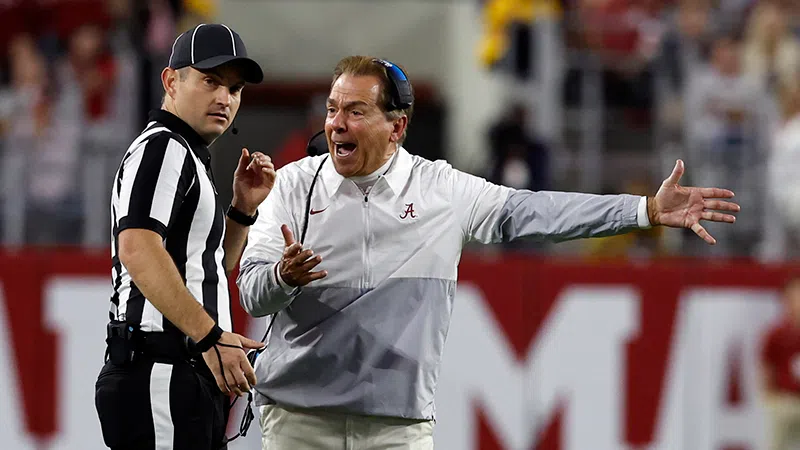
No part of me is going to try and wrap my head around Hunter Yurachek’s decision making in general. The moment he dropped a “6-7” reference on national television during the weekly rankings reveal was the moment I stopped taking him seriously.
No matter the logo that was shown next to the No. 9 and No. 10 spot on Sunday’s show, there was going to be disagreement and disappointment. And it was most likely going to come at the expense of three blue bloods that opposing fans love to hate. Here’s my takeaway from it all.
On the 12 Team Field and Rankings Overall
It took roughly two minutes into the reveal for me to yell at my television. Ohio State lost to Indiana in the Big Ten Championship less than 12 hours before the rankings were released. Georgia beat the brakes of Alabama in the SEC Championship Game a few hours prior to that. Somehow Ohio State only dropped one spot to No. 2 and Georgia didn’t move at all after a 28-7 drubbing over a top ten team.
For the last week or so we kept arguing and debating the significance of conference championship games. The debate centered around whether or not a loss in the conference championship should drop a team like Alabama or BYU out of the field. I argued that dropping Alabama out of the Top 12 after a loss in the SEC Championship game would be unfathomable because it basically would mean the game doesn’t matter anymore.
That was correct. However, it turns out that the game apparently didn’t matter if you lost or won.
I genuinely didn’t even think there would need to be an argument for Georgia jumping to No. 2 with a win Saturday. The Big Ten Championship loser would drop to No. 3 with all three teams still at the top. The way Georgia won should have been enough of a statement. But, if it wasn’t then let’s look at the entire resume.
Both Ohio State and Georgia are 12-1. Ohio State finished the year with just three games against currently ranked teams, and went 2-1 in those games. Georgia played five, and went 4-1. That’s not only better than Ohio State, it’s the most of any team in the country. They also had the 15th ranked strength of schedule compared to 30 for Ohio State, and had a better strength of record at No. 2 versus No. 5.
Notre Dame’s cries may be the loudest, but the biggest gripe of anyone in the field is Kirby Smart’s 12-1 SEC champs staying at No. 3. But, hey, SEC bias right?
Alabama deserved their spot
It felt like when the committee moved Alabama to No. 9 last week that they were in no matter what. Several sportsbooks agreed and shifted lines to -500 to -3000 in some places. If they were playing with house money, it sure looked like it. Not only were they completely blown out, but all the struggles brought up about this team for the last month were on full display. The run game that Yurachek bizarrely brought up a few weeks ago was not just bad, but historically bad finishing with minus-3 yards rushing.
They played with fire in Atlanta, and somehow didn’t get burned.
You can yell all you want about Florida State, or close wins to “bad teams.” But, the biggest disservice during most debates over the last several weeks was focusing on bad losses or close wins instead of clearer metrics. Alabama is ranked higher in strength of schedule, strength of record, ranked wins, and opponent win percentage. They also beat Georgia at their place in September and then won three more games against Top 25 teams in consecutive weeks.
Alabama is a flawed team, but looking at that body of work in comparison to Notre Dame and Miami teams that were at home on Championship Saturday would have been a joke. Especially considering that Miami couldn’t find their way into the ACC Championship game over the likes of Virginia and five-loss Duke.
Notre Dame got what they deserved
Notre Dame is a really good football team. But, there was not a case to be made for them over Alabama or Miami that wasn’t rooted in hypocrisy or hypotheticals.
“Sure we lost to Miami but that was in week one, and we’re a much better team now.” That logic would essentially nullify Alabama’s Week One loss to Florida State. The argument that quality losses to Texas A&M and Miami should matter more than the lack of quality wins is hollow.
Notre Dame has been given every advantage imaginable in college football. They don’t have to play in a conference. The conference they aligned with to play five games against every year is the weakest among the Power Four. It’s the only team in the country who was allowed an automatic bid to BCS or New Year’s Six bowls with ten wins. It’s the only team in the country that’s ever won a Heisman trophy during a 2-8 season. And, it’s the only team didn’t play a single true road game from week three to week 14 last year.
This was long overdue, and more than anything it was deserved.
‘Whew’ for The U
The Canes should absolutely be ahead of Notre Dame considering their head-to-head win. But, what was the committee doing for the previous month with their ranking and positioning? That win over the Irish was in week one. They’ve been a minimum two spots behind Notre Dame every week for the last four weeks.
Now, after a weekend where neither team played, the committee jumps them from No. 12 to No. 10? That makes no sense. Regardless, it was the right move, and if nothing else, it was great way to break up the monotony of having a first round of CFP games with three rematches, as Notre Dame was projected to play Texas A&M.
On BYU
BYU had a great season. They were a fun team that seemed to spend the first two months of the year proving everyone wrong. Having only one loss in the regular season to a top five team was a great argument for inclusion. Their 34-7 loss to Texas Tech in the Big 12 Championship Game was a big enough reason to be left out.
The biggest discrepancy with BYU this season is how unfairly and continuously dismissed and overlooked they were. How many times did we see a side by side graphic comparing resumes of Alabama, Miami, Notre Dame, and even Texas. BYU was routinely left out, and there was no reason for it. Again, they didn’t deserve to make the CFP, but it’s a shame they weren’t talked about more leading up to it.
The real villain
College football always needs a villain. Having Notre Dame, Miami, and Alabama at the center of the most heated and important debates definitely delivered one–or three.
But, if you’re looking for a real villain it’s none of those. It’s the Group of Six schools and the committee themselves.
College football is better when relevance is dispersed nationally and not just regionally. I miss the Pac 12, and wish the Big 10 still had something closer to their namesake with ten teams instead of nearly 20.
I love the little guys and Cinderella stories. But forcing a G6 automatic qualifier every year needs to be reassessed before next year. I’m ok with one team making it if it’s deserved and will deliver a competitive first round game. Maybe adding a G6 team at the 12 spot was going to result in some annual Boise State beating Oklahoma in the Fiesta Bowl moment, or 12-vs-5 March Madness upsets on the football field.
There is no part of me that wants to watch James Madison play anyone, but especially Oregon. And now, this year because of the poorly constructed admission criteria, we got two teams in the field.
There’s no compelling storyline for either of these teams. To make it even worse, both teams have a head coach that’s leaving for a power four job as soon as their inevitable 30-point loss in the first round happens. One of those games is a rematch from a game already played this year when Ole Miss beat Tulane 45-10.
By their own rules, both teams deserved to get in because they were a part of the top five ranked conference champions. But, come on. Give me Notre Dame going to Oxford to play Ole Miss. Or give me Diego Pavia and Vanderbilt going up to Eugene to play Oregon.
Six to eight teams is the sweet spot for the playoff. That’s my opinion. What’s not an opinion is that it doesn’t matter how many teams are in the field, there will always be some deserving team left out. When we had the BCS format we complained that we needed four teams. We got to four teams and then complained that several teams ranked No. 5 deserved to be in, and we needed more. So we went to 12. Now people are clamoring for 14 or 16. It won’t end, and if they made it for 64 or 130 teams we’d complain about who was 65th or 131st.


More SEC News