
Steven Branscombe-Imagn Images
By Hunt Palmer
Many of the LSU baseball players are already home for the holidays.
Fall ball wrapped up two weeks ago. The Tigers concluded six weeks of work including trips to Biloxi and Hammond for extended scrimmages with Samford and Southeastern Louisiana. Finals are wrapping up this week, and the team will reconvene the second week of January to prepare to start the 2026 season.
I’ve spoken with some sources inside the program to see where things stand entering the break. Fall is a lot of baseball, but the five weeks between the return to campus and first pitch create a lot of variability, not to mention the four pre-conference weeks in late February and early March.
In short, where things can and very much will change by the time LSU opens SEC play at Vanderbilt on March 13.
OUTFIELD INTACT
There aren’t a lot of variables in the outfield.
First of all, Derek Curiel is fine. The internet started buzzing a couple of weeks ago. He tweaked his ankle in the weight room and will be ready to go when the spring semester rolls around. He’ll play center. Ho hum, he was second on the team in hitting this fall. Chris Stanfield will play left, and Jake Brown will play right. Brown saw some left-handed pitching this fall and hit it hard including a home run.
LSU probably boasts the best outfield in college baseball.
CORNERS COMING ALONG
Right now, Trent Caraway is the favorite at third base, and Zach Yorke is the favorite at first base.
Both guys have really impressed with their defense, especially Caraway. That was a pleasant surprise. We know how big a variable third base defense in the college game. A good one is a game changer. Most teams have a slick glove at shortstop, but sometimes there a bat “hidden” at third that can be a problem defensively. Caraway has handled himself wonderfully with the glove. Jay Johnson has worked some wonders with transfer hitters, and Caraway is making big changes to his offensive game. Last year wasn’t very good for the slugging third baseman. He’s a huge talent that is probably penciled in toward the bottom of the starting lineup. If it clicks, look out.
Yorke really fits into the lineup well. He moves better than you’d think at first, and he hit a ton in the fall. He doesn’t have to cheat to get to his power. So, he maintains a good, short swing that produces a lot of line drives and some longballs when he catches the ball out front. He won’t hit 23 homers like Jared Jones, but he’ll probably hit 13-15 with far less swing and miss.
SHUFFLE AT SECOND
Second base is really the only question mark on the diamond. It’s likely a few guys get a shot there in the early going. Brayden Simpson and Seth Dardar had awesome offensive seasons last year. They’re veteran guys. Tanner Reaves is more comfortable defensively at second than he was at third, and he can still provide some solid offense.
I think all three will get early at bats and innings. Some of it may be matchup dependent. Some if it may be the hot hand. Designated hitter is also an option to keep them all engaged.
CADE AT CATCHER
I was fired up to see Cade Arrambide as the team’s leading hitter in the fall. He edged Derek Curiel with a batting average well north of .400. The LSU staff feels like last season was the perfect introduction to college baseball for Arrambide. He got 36 games of action, 19 starts and 75 plate appearances. He produced seven extra base hits and improved defensively. Then he went out in the summer and got more playing time on Cape Cod.
Now Arrambide is ready to showcase that special skillset at catcher as a 20-year-old. He’s got power, agility and some wheels for the position, not to mention a big throwing arm. There is a very high ceiling here. How close he gets to it could be a big indicator of how LSU looks offensively. The fall was a superb start.
STARTER SELECTIONS
Casan Evans took the summer off after a huge workload as a freshman. He was back on the mound in the fall and looked great. He’s very, very likely going to get the ball on Opening Day, and the staff feels great about that.
Where the rest of this shakes out is very much up in the air. Keep in mind, at this time last year Anthony Eyanson was not really at the top of the list as a starter.
The real contenders for a weekend spot behind Evans right now are Cooper Moore, Zac Cowan, William Schmidt and Cooper Williams.
Moore was Kansas’s ace last year and provides the highest floor of the group. Is he a Friday night SEC ace? Probably not. But he’s extremely capable on Saturdays and would be an advantage for LSU on Sundays.
Schmidt was up to 99 mph in the fall and threw a ton of strikes. That’s a huge positive for a guy who walked 11 in two SEC innings last year. Schmidt’s fastball-slider combination is lethal. He’s working on the curveball and the changeup to make sure there is a “softer” pitch in the mix. He’s got both as weapons. More consistency is needed for him to become a reliable five or six inning SEC starter.
Cowan offers the same high floor as Moore. They’re very similar pitchers, undersized right handers with more of a pitch mix than dominant stuff. Both posted a strikeout-to-walk ratio of better than 4.5-to-1 in the power four last year.
Williams is the left hander most in this mix. He’s proven he’s really effective in a six-to-eight out situation like we saw in the postseason last year. Is he ready to take the ball for six innings? That’s the hurdle he’s going to have to clear. I don’t see a real plus pitch from Williams when I watch him, but he’s constantly in the strike zone. He left-handed. He’s lanky and can get it up there at 92 mph.
My concern with this roster, if I have to find one, is the lack of huge upside in this starter group beyond Evans and Schmidt. When I posed that to a source inside the program, the feeling was that replicating Anderson-Eyanson annually is a high bar to clear. However, if the bullpen, which does have massive upside, pitches to its potential, you can shorten games from the back end instead of the first six innings.
It makes sense. All outs are created equal. That said, if Evans and Schmidt as are good as they could be, it’s a moot point.
BULLPEN BULLETS
This may be the aspect of the team the coaching staff is most excited about.
There’s real firepower in the LSU bullpen.
Deven Sheerin looks fantastic coming back from the torn ACL. He’s throwing in the high 90s with hard breaking stuff. At 6-foot-5 and 245 lbs., there may be even more in that arm as he continues to pitch deeper in the season. “Awesome,” was the reaction when I brought up Sheerin’s name.
Gavin Guidry really impressed in his return to the mound this fall. He’s throwing four pitches now, something I thought I saw in one of my scrimmage looks. He struck out five guys in two innings when I saw him. This time last year, Guidry was a starting option. He’s probably not right now because of the injury last year. Bullpen is probably his home, and that’s a great weapon based on his stuff and his demeanor. Guidry is a different pitcher than the last time he took the mound in Chapel Hill.
Marcos Paz looks like a dude. He’s only going to be 18 months post-Tommy John when the season starts, so he’s going to be eased in. But it’s upper 90s right now with a ton of strikes. Paz is not a candidate for long work in February and March. It will be shirt stints of high octane stuff. At 6-foot-2 and 220 lbs., he’s 25 lbs heavier than Evans is listed today. He’s got all the upside.
And maybe the surprise name I heard was Grant Fontenot. He was dominant all fall. Why? “Some guys just develop at different speeds,” a source told me. Fontenot has always thrown pretty hard, even in his first stint at LSU. When he left, Texas took a shot on him. So, talent has never been an issue. There’s real hope Fontenot can be a high leverage reliever.
Mavrick Rizy certainly has that look, as well. Joe Healy of D1Baseball said on the Highway to Hoover podcast that Rizy threw the best inning he saw on Cape Cod all summer with that high 90s fastball and good slider.
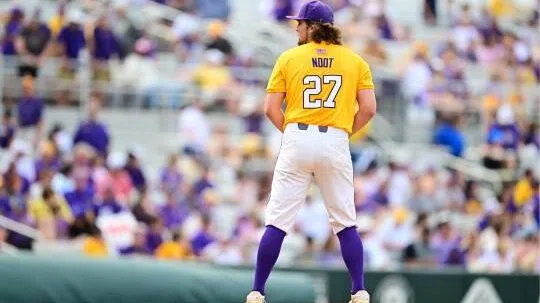
Jaden Noot always feels like the forgotten man, but he really made strides last season. In SEC action, he had 12 strikeouts and two walks with an opponents’ batting average of .194 in 9.1 innings.
That’s six names plus whatever is left over from the starter group that the staff feels could be an elite bullpen.
LEFTIES LOOMING
That above group all right-handed, and Williams is the only lefty in the top starter mix. That doesn’t mean LSU is short on lefties.
The staff is very, very high on transfers Santiago Garcia from Oregon and Ethan Plog from junior college. They don’t throw 97 mph like most of the above names, but they’re strike throwers that ate lefties up much of the fall. Garcia threw high leverage innings for a good Oregon team last year. Plog is the awkward left-hander with a short arm delivery and good spin on the breaking ball that makes life tough on left-handed hitters. Those two nailing down prominent bullpen roles could free Williams up to start from the left side.
Danny Lachenmeyer is another talented southpaw that will compete for time. DJ Primeaux is also back, and he made 10 SEC appearances last year. So, while the headliners are right-handed, LSU does have options from the other side.
I haven’t covered every single thing here. For instance, Omar Serna showed his massive power at times in fall, and I think Mason Braun might be a start at LSU by the time he’s done. Yorke is just more advanced as a fourth-year player, so Braun is blocked at first base and can’t break into an elite outfield.
That’ll put a button on LSU baseball for the 2025 calendar year. Just two weeks into 2026, they’ll be back out there grinding away. Hopefully next year goes a little bit like this one.


More LSU Sports