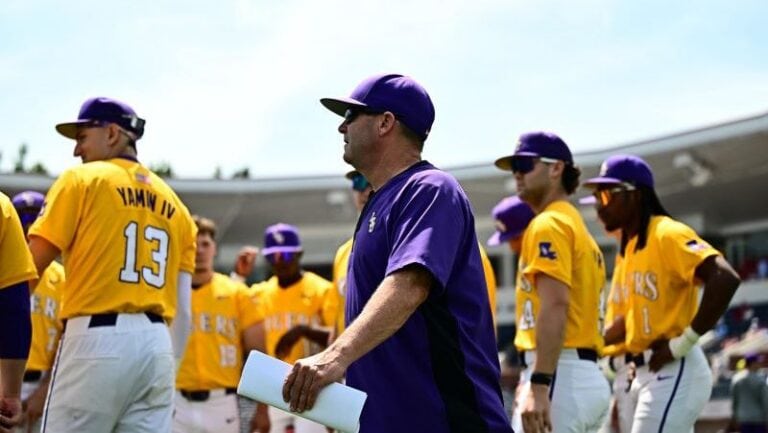
Shortstop conversations in Baton Rouge must now include Steven Milam.
The diminutive defensive wizard won’t boast the gaudy numbers of Brandon Larson or the draft profile of Alex Bregman. Jason Williams littered the LSU and SEC record books from 1993 to 1996. Milam may not quite reach some of those. He may not play as long as Ryan Theriot did at the next level.
In purple and gold, Milam’s legacy is going to rival them all, though. He added to that on Friday when he announced his return to LSU for his senior season.
In three seasons, Milam has made a pair of All-Regional teams and a College World Series All-Tournament team. He clubbed a walk off home run to beat Wofford in the Chapel Hill Regional opener as a freshman. Last summer, he took a blowtorch to West Virginia’s pitching staff in the Super Regional to the tune of two doubles, a grand slam and eight runs driven in. He followed that up with seven more hits in a brutal offensive environment in Omaha.
Meanwhile, he played shortstop as well as any defender in Division 1. Forever, the Alex Box Stadium scoreboard will feature his double play turn to deliver the program’s eighth title.
He returns to try to deliver No. 9.
What he also represents in the process is the new perspective of flawed draft prospects in the NIL and revenue sharing era. From a numbers perspective, Milam is a draftable player. He’s an elite defensive player at a premium position who hits for some power from both sides of the plate and has a track record of SEC success. However, he’s listed at 5-foot-8. And he’ll be 5-foot-8 five years from now.
That deflates draft helium and rakes professional dollars off the table at the same time. Milam, in my estimation, is a fourth to sixth round pick. The first pick of the fourth round is worth about $755,000. The last pick of the sixth is worth $330,000.
Milam could take that payday and enter the minor league ranks where very few reach the promised land. Or he could cash in some or all of that amount at LSU to chase another championship with teammates on charter flights and ESPN2.
He’ll get less money from the MLB next summer when he’s a year older and potentially without leverage. We’ll see if five-for-five passes this year or not. But the financial side could be something of a wash. He just gets to play the type of baseball he prefers in 2027, playing for a team purpose in front of 10,000 people with a chance at returning to Omaha instead of playing for the Trash Pandas or Biscuits or Sand Hens in front of 750 in Nowhere, USA.
For those elite draft prospects that come through LSU, the Dylan Crews, Kade Anderson and Derek Curiel types, this option won’t make much sense. Even players like Ethan Frey and Griffin Herring will command more money than LSU is likely to be able to counter with despite not being first or second round picks.
Those guys are more projectable.
Milam’s announcement rekindles memories of Jared Jones spurning the draft to chase another title. He’s kind of a one tool player. But that power tool hit more home runs than any three-year player in school history. Jared Poche and Greg Deichmann both did this in 2016-17. Poche bailed on pro ball quickly, and Deichmann only briefly made the Major Leagues.
All three of those players reached the College World Series final in their LSU encore. Milam stated that as his goal in his return video.
Whether he does or not, he’ll be one of the best shortstops in LSU history moving forward.