Stretch a rubber band enough, it snaps.
For six years, collegiate athletics eligibility has been pulled and pulled. Tuesday, it snapped.
Tony Petitti and Greg Sankey assembled the members of their respective conferences and got all 34 members to agree that players who declare for the NFL, NBA or WNBA draft without withdrawing, sign a contract with those leagues or affiliates or are listed on a roster cannot play collegiate athletics.
For now.
Ultimately, between the conferences and the lawyers representing players, someone has to buckle. The attorneys indicated on Tuesday that they have no intention of doing so currently.
Yahoo!’s Ross Dellenger spoke with attorney Ryan Downton who says the NCAA “should be held in contempt of court” for allowing its conference members to violate court orders. Dae’Quan Wright’s counsel, Darren Heitner, also told Dellenger the Louisiana injunction from a week ago provides “a colorable argument” to cover conference-wide policies as well as NCAA rules.
Round and round we go.
My instinct is that the commissioners of the conferences hold the power to suspend coaches and impose fines for playing players deemed ineligible. Maybe a judge says the player can play. The league can determine that will come with punishment. Conferences have long held the power to fine universities for storming the playing surfaces. Programs have been stripped of the right to compete in postseason tournaments. At a certain point, there were some rules.
I’m no lawyer, but without rules governing competition, how do we move forward?
I don’t find what Wright, Zxavian Harris and the other Class of 2022 football players are doing malicious. They aren’t cheating or operating in the shadows. This is not getting caught on a federal wiretap negotiating with player, the Astros banging trash cans or cyclists blood doping.
Everyone else got five years. These guys want it, too. And there are hundreds of thousands of dollars at stake. In some (literal) cases, it’s seven figures. That’s probably worth going to court over. The only difference in Wright and Harris’s situations as opposed to Junior Tuihalamaka is that they chose to pursue more football after they were told their time in college was up.
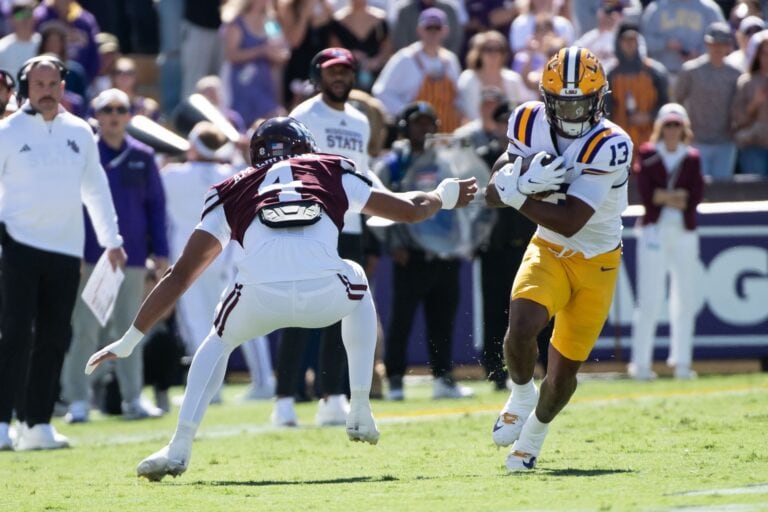
Tuihalamaka, like Donovan Dent on the basketball side for LSU, just gave it up. Now, he’s being rewarded for that. I’m perfectly okay with Tuihalamaka returning, but it wasn’t like he was holding out hope that a court ruling would show up on July 31. His last game was in November. He got lucky. Wright and Harris are being punished by a six-figure sum for exploring the only step possible as of January– the NFL.
The visual of Wright in a Browns uniform was the tipping point. The internet and powers that be decided that after six years of nearly boundless eligibility loopholes, the one that had to be closed was practicing with NFL and NBA players.
They gave the COVID year back. They ruled junior college seasons didn’t count. They grandfathered in injuries to the tune of seven or eight-year careers. They allowed pros to come from Europe. They were lenient on sore tonsils. The Browns uniform finally snapped the rubber band.
That will cost LSU a backup tight end and a rotational defensive tackle with big game experience on the gridiron. It cost Will Wade the 2024 Big East Player of the Year in RJ Luis and Saliou Niang who was drafted by Cleveland in 2025.
Both programs will survive, and life will go on in Baton Rouge. The same goes for Lexington, KY., where Mark Mitchell attempted to jump from Missouri to Rupp Arena with the Wildcats. Dozens if not hundreds of players seeking a fifth year, most of which have no affiliation with LSU, will fight in court. I have no idea what their ultimate fate will be. If they didn’t suit up for the Browns or play for the Celtics in the preseason, they may have a fighting chance to play again.
My hope is what comes of this is an end to the absolute circus of a legal process that collegiate eligibility became once COVID struck and millions of dollars were introduced. Maybe these commissioners have done just that.
On the field, collegiate athletics is as healthy as ever. Television ratings are up. Teams that win are filling stadiums. Facilities are immaculate. The cash registers are ringing. Level of play is often exceptional.
At the same time, no one is really able to discern what the rules are or who is calling the shots. The NCAA tried and failed. The conference commissioners are now swinging their stick. Meanwhile, we still have talk of the SEC and Big Ten breaking away. Stanford and Cal play in the Atlantic Coast Conference. Members of that league are actively looking for a way out of an antiquated media rights deal, and no one can determine how many teams should compete in the postseason tournament in basketball or football. Lawyers are yelling about leagues being in contempt of court.
Somehow, it’s all got to get put back together. Anyone got a rubber band?