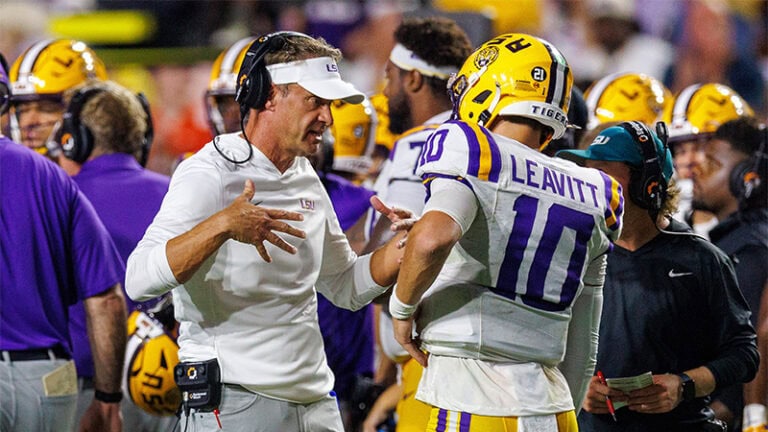
Sam Leavitt trusted his legs in Oxford.
Under a steady rush throughout the game from the Ole Miss defense, Leavitt consistently took his eyes off the field and looked for an escape route on the ground.
The Rebels were credited with 29 pressures in the game, 23 hurries, five sacks and a hit on the quarterback. LSU’s offensive line struggled to give Leavitt time, so he started running.
While head coach Lane Kiffin recruits athletic quarterbacks who can create things off schedule, playing on schedule is still paramount to the offense’s success.
Entering the Texas A&M game, he made sure Leavitt was aware of that.
“That was a big emphasis from the week was to trust the receivers, throw things on time, don’t try to make extra plays,” Kiffin said. “If (the receivers are) not going to make the plays, let them show us that, you know, but let’s give enough opportunities to show us that before you feel like you got to make more plays with your own feet at quarterback.”
Leavitt obliged for three main reasons.
First, his offensive line held up. Texas A&M only generated nine pressures, and the starting offensive line was only dinged for three of those.
Second, the coaching took hold. Kiffin and offensive coordinator Charlie Weis Jr. have had consistent success developing quarterbacks. Leavitt is the next in a long line of signal callers to show marked improvement.
Third, Leavitt’s tweaked hamstring didn’t allow him to run away from the Aggie defense. He frequently hobbled between plays. During the action, he looked calm and collected, surveying the field and delivering the ball on time.
“We kind of joked, but it really happened,” Kiffin said. “The injury helped that, too. If I know I can’t run, I told him, you now are like the old school pro-style passer that knew he couldn’t run. He better throw it on time or he’s going to get sacked. And so, you know, we say all the time some things happen that have a cost but also have a benefit.”
The hamstring injury acted like a biological training aid.
Leavitt completed four of his six throws that traveled over 20 yards, two went for scores. He was 6-for-10 (60%) for 235 yards on balls that traveled at least 10 yards in the air. That’s 39.1 yards per catch.
His passer rating when kept clean was 92.2 on Pro Football Focus. LSU generated nine passing plays of over 15 yards.
A&M has struggled in the secondary and doesn’t feature a feared edge rusher currently. Tougher defensive tests await Leavitt and the Tiger offense, but Saturday provided proof of concept for Leavitt and LSU.