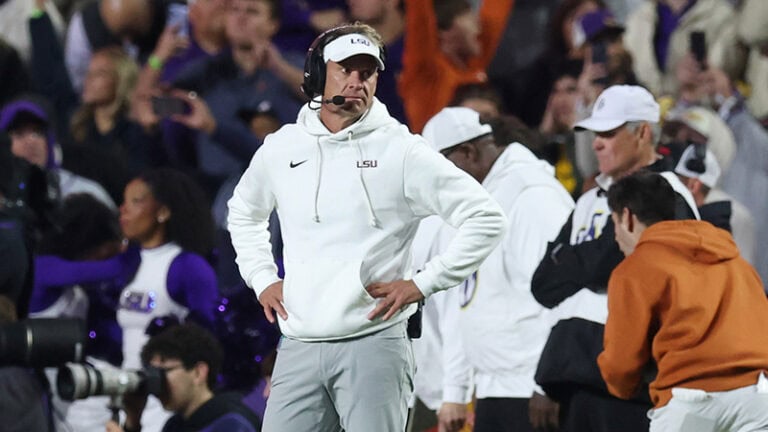
Here lies the worst good team in LSU history.
Nov. 14, 2026. Cause of death: Situational ineptitude.
This is a good football team. That’s an opinion that is sure to be challenged. It’s also a failure of a football team. No one is going to fight me on that one.
These Tigers have played four competitive games and posted a stunning 0-4 record. The other six have been maulings that allowed thoughts of serious Year 1 accomplishments to creep in.
Head coach Lane Kiffin’s team has outgained its opponent in nine of 10 games and won the yardstick by an average of 228 yards per game. That’s a staggering statistic. The Tigers outpace their opponents in terms of first downs more so than any team in the country.
That’s a footnote in the obituary, but the team is deceased. The program, however, is not.
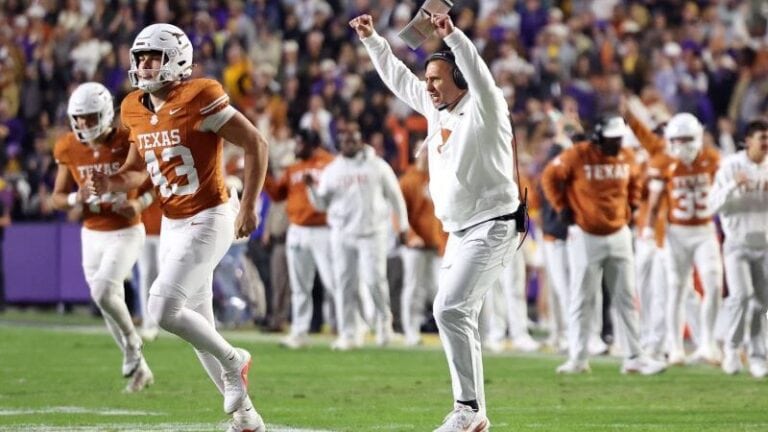
College football’s edge is razor-sharp, and as Texas running back Raleek Brown galloped inside the south end zone pylon, that razor sliced LSU deeply like Kenny Minchey’s two-point dash in Lexington and Sam Leavitt’s tipped and intercepted pass on fourth-and-goal in Oxford.
If one of those plays goes differently, LSU is alive. If two do, a 50/50 split, LSU is in the top 10. None did, so LSU is toast.
The Tigers have lost the fourth quarter, 23-0, over the last two weeks in Death Valley. The offense has reached the red zone nine times against Alabama and Texas and has three touchdowns and four turnovers to show for it.
Much of that falls at the feet of a quarterback who put the ball in harm’s way three times on Saturday. All the interceptions were dreadful decisions by a player in his third year as a starter and fourth year in college.
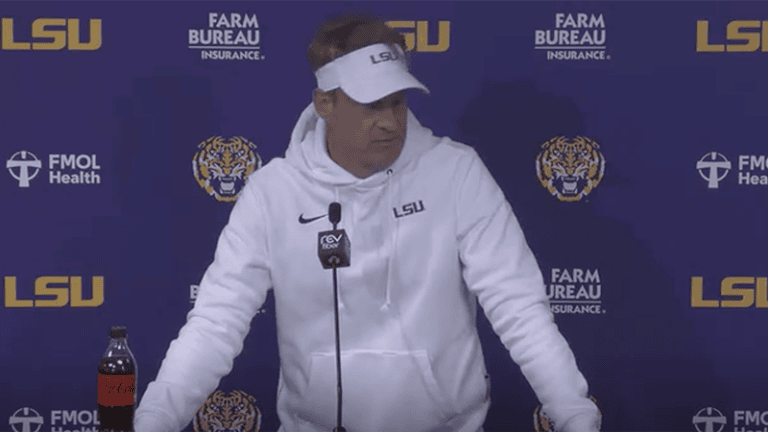
Kiffin suggested after the game his offense’s conservative fourth-quarter approach had plenty to do with the fact that the quarterback had floated the ball into trouble three times.
LSU’s offense lost a yard in total on four fourth-quarter drives. Four punts. If any points are scored there, LSU probably wins.
Cue the Amazing Grace. Put on the black suits and black ties. It’s over.
However, there is reason to believe in the program beyond the 2026 team. That’s hard to fathom in the heartbreak of a fourth-quarter collapse against Alabama and a gut-wrenching final play from scrimmage against Texas. But it’s true.
Fielding a statistically strong team with results that don’t match suggests some progress. Neither the offense nor the defense on this team appears broken unless the offense is inside the opponent’s 20 or the defense sees less than two minutes on the game clock.
The question becomes whether or not Kiffin can walk into the boosters’ offices and living rooms to ask for another $40 to $50 million. Last winter, LSU had a surplus lying around thanks to the revenue-sharing rules and dumped it all into this group.
The ROI has been zero.
The revenue can be shared again, but the NIL payments have to be re-upped, and that’s going to be a brutal conversation. Maybe Maryland will hire Brian Kelly to free up some of LSU’s cash.
Meanwhile, Kiffin will likely be asked about red-zone failures, the inability to get stops late against Ole Miss, Kentucky and Texas as well as what the plan will be at quarterback.
All three aspects will have to improve next fall.
LSU has fielded plenty of bad football teams over the years. Plenty of Tiger coaches have seen their programs drift into mediocrity or worse. That’s the case with this team, not the program.
The offensive scheme isn’t behind the times. The defense doesn’t have a glaring flaw. Neither unit has made plays at winning time. That’s a trait of championship teams. This ain’t that.
Kiffin’s honeymoon is over. That wedding vacated the church in December. Now it’s time to make room for services for the 2026 team.
LSU didn’t hire Kiffin to win the national title in Year 1. He was hired to cultivate a championship program. His hope is that some seeds have been planted for that development.
They say decomposition creates fertile soil.
Dig the grave.