With LSU football retiring the jersey No. 7 of Bert Jones on November 14, 2026, LouisianaSports.net is publishing a series about Jones called 7-on-7 … one story each day for seven days leading up to the jersey retirement ceremony.
The series is written by Pulitzer Prize winner Jeffrey Marx, author of six books including Walking with Tigers: A Collection of LSU Sports Stories.
At age 75, his high-profile days of gridiron glory now catalogued mostly in distant memories and repurposed YouTube videos, Bert Jones still gets compliments from football fans.
It happens in his home state of Louisiana. It happens across the country. It happened last summer while he was visiting the Czech Republic.
People see him out on the street or in a restaurant or wherever. They’re usually pretty certain it’s him but not always entirely sure.
“Bert Jones?”
“Yes,” he says.
“You were the best.”
Or it might be: “Thanks for the memories.”
The comments vary.
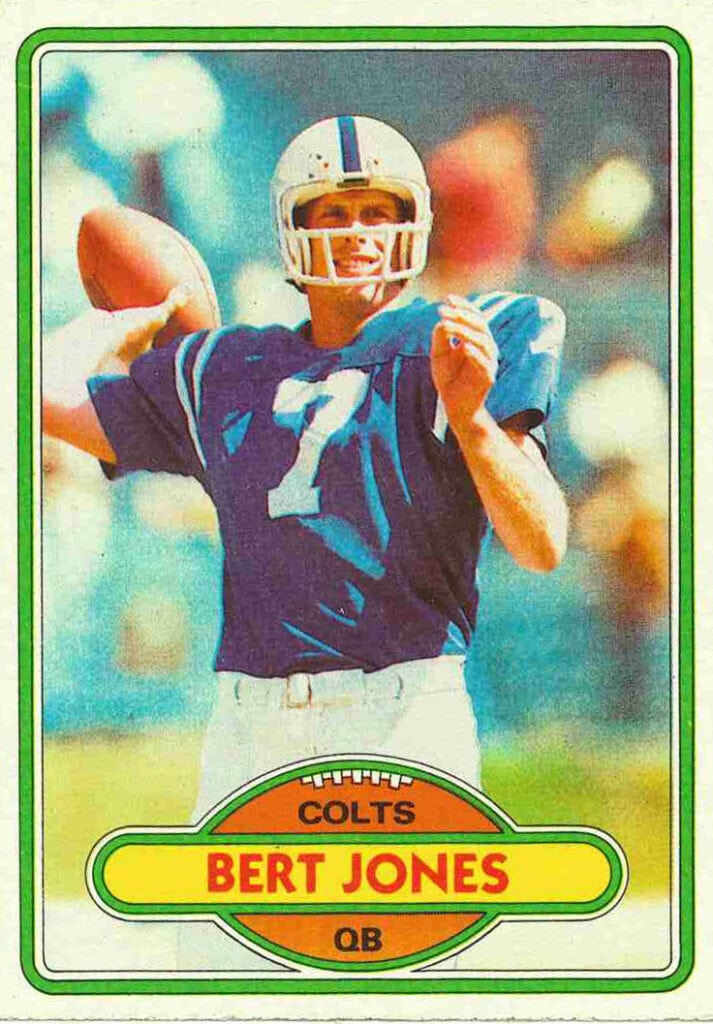
Bert’s response often begins the same way: “Well, thank you. You must be a history major.”
He raises a good point.
Half a century has passed since Bert was named 1976 MVP of the National Football League.
So – for young folks and anyone else not majoring in the study of long-ago sports – a brief lesson in NFL history:
Once upon a time, the Baltimore Colts were one of the best teams in the league. Yes, the Baltimore Colts. In the early 1970s, their heroic quarterback, a guy by the name of Johnny Unitas, finally aged out of greatness, so the Colts needed someone new.
They found him in Baton Rouge and traded for the draft pick needed to get him. With the second overall selection of the 1973 NFL Draft, the Colts selected Bert Jones, Ruston boy and LSU All-American.
Colts general manager Joe Thomas, who had earlier helped build Super Bowl teams with the Minnesota Vikings and Miami Dolphins, was effusive in his evaluation: “Bert Jones is the finest quarterback prospect I have ever seen come out of college football.”
Bert temporarily left behind his hunting gear and headed north.
*******************************
Taking over the position long held by Unitas – four times an NFL champion, three times the league MVP, worshipped in Maryland – was like walking on stage at Carnegie Hall and being asked to sing right after Frank Sinatra.
Bert had all the tools: size and smarts, drive and determination, an overwhelmingly positive attitude and most definitely the arm to be successful.
But he still had a lot to learn. He initially failed to hit all the notes just right. And the chorus surrounding him definitely needed work.
Bert won the starting quarterback job for the opening game of his rookie season but ended up sharing the position with veteran Marty Domres for two years.
They were terrible seasons. Both ended with the Colts in last place of the AFC East Division (with records of 4-10 in 1973 and 2-12 in 1974).
If nothing else, there was at least a Jones family highlight in the 1974 season finale. In a shootout against Joe Namath and the New York Jets, a 45-38 loss for the Colts, Bert had a stretch of 17 consecutive pass completions. No NFL player had ever completed that many passes in a row – making Dub and Bert Jones the first father-son duo in the league record book. (In 1951, Dub had earned his entry by scoring six touchdowns in a single game for the Cleveland Browns.)
Bert did not really care about setting an individual record, though. He wanted to start winning.
*******************************
A new coach – Ted Marchibroda – took control of the Colts in 1975. He tutored Bert during the off-season. A bond was built and Bert became the permanent starter at quarterback.
The early season looked bad again: only one win in five games. Then everything changed.
Bert started shining – his rise as one of the best up-and-coming quarterbacks in the league gaining momentum – and a young group of talented players grew up right along with him. Leading rusher Lydell Mitchell at running back. Speedster Roger Carr at wide receiver. An offensive line bolstered by the new addition of All-Pro George Kunz. A hard-charging defensive line known as the Sack Pack. Leading tackler Stan White at linebacker. Bruce Laird at safety.
“Special group of guys,” Bert says. “We had a lot of fun together.”
They also went on a remarkable run: nine straight wins to go from “worst to first” and claim the AFC East title. It was then the biggest single-season turnaround in NFL history.
Bert’s personal progression was equally stunning.
He could always throw. He was always an intense competitor.
Now he was also reading defenses better than he ever had.
And he was the undisputed leader.
“Not only for the offense,” says Joe Ehrmann, who was a defensive lineman and co-captain. “All the guys on defense looked at Bert as our leader, too. That’s not how it usually works. It’s typically offensive players looking to someone on offense and defensive players looking to one of their own guys. Bert had everyone following him. And his leadership seemed so organic – just part of who he was.”
Kunz saw it every time the offense huddled: “Bert had the ability to look at you and let you know what he was thinking. He also had the ability to listen to his teammates and respond to whatever he was hearing. He had the humility to listen. Some quarterbacks don’t have that.”
As an offensive lineman, pounding away in a role that often goes unnoticed until something bad happens, Kunz also appreciated how Bert routinely reached out to pull his linemen in – both on the field and away from it.
“When he went goose hunting, he invited you,” Kunz says. “When he was doing something at his house, he invited you. Bert always took the time and made the effort to be very inclusive. Not only in what he did but also with the credit he got. That was refreshing.”
*******************************
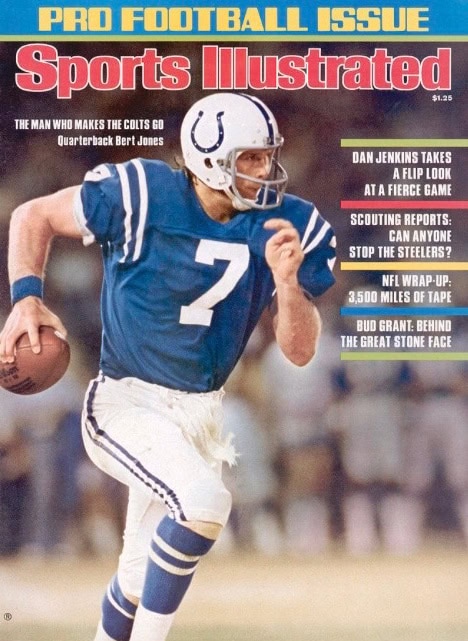
In 1976, Sports Illustrated featured Bert on the cover of its preseason pro football issue: The Man Who Makes the Colts Go. The editors chose well. Bert followed with his league MVP season and the Colts – finishing at 11-3 – repeated as AFC East champions.
Bert led the NFL in passing yards (3,104) and threw a career-high 24 touchdown passes. The Colts were the best team in the league at moving the ball (5,236 total yards) and at scoring points (almost 30 per game).
For the second straight year, though, they lost in the first round of the playoffs. Both times they were beaten by the reigning Super Bowl champions. Both times that was the Pittsburgh Steelers, who had a generous collection of future Hall of Famers, including an old friend of Bert’s from Louisiana, quarterback Terry Bradshaw.
*******************************
The next year brought heightened expectations.
With back-to-back division titles behind them and the bulk of the team returning, the 1977 Colts were ready to advance deeper into the playoffs. They were thinking Super Bowl and perhaps even championship rings.
“That’s when I thought it was going to happen,” Bert says. “I thought we had a chance to go all the way. Our team had matured both physically and mentally. It was time.”
The Colts won a third straight AFC East title. They again got to play at home in the opening round of the playoffs. They again – third time in a row – were matched against the defending Super Bowl champions. This time it was the Oakland Raiders.
The game went back and forth. Both teams had multiple chances to seal victory in regulation time. It never happened. Tied 31-31, the Colts and Raiders went to overtime. And the rules were different then. Overtime was sudden death from the start. First team to score would win. The team kicking off might never even get to play offense.
The Colts won the coin toss and got the ball first. On third-and-eight at their own 40-yard line, they went for a big pass. Bert dropped back to throw from about the 30. Tight end Raymond Chester was wide open nearing the opposite 30. “Nobody guarding me but God and the air,” he’d later say. But Bert missed him – the ball sailing just over his head.
Vince Bagli on Baltimore’s WCBM radio broadcast: “Boy, if that’s not a touchdown, it’s awful close, if Bert can connect.”
If not a touchdown, a completed pass would have at least put the Colts in good position to win with a field goal.
Instead, they had to punt. Walking toward the sideline, Bert unsnapped his chin strap and threw his head back in frustration. He stared at the sky.
Nobody scored in the first overtime period.
In double overtime, Oakland quarterback Ken Stabler threw a game-winning touchdown pass to tight end Dave Casper. There would be no Super Bowl for the Colts. Their season was over.
Bert long ago moved on to other things. But he has never entirely dismissed that one play from that one epic game.
How did I miss Raymond Chester? How did I not make that play?
He has never watched film of it … says he never will.
Without any visual aid, though, he still sees that ball flying over the outstretched hands of his tight end. The biggest what-if play of his career even reaches out from the 1970s and shows up in his sleep.
“I don’t call them nightmares,” Bert says. “But I have recurring dreams about it. Hasn’t happened in a while. But it happens. I still see that play … pretty big moment in my life. I mean, that one goes to the grave with me.”
*******************************
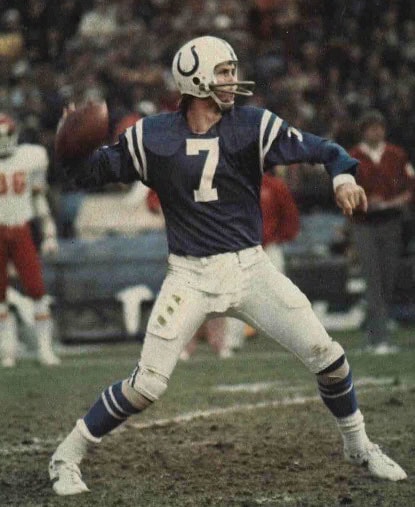
There were two other major what-ifs in his football life. Bert does not dwell on them. But he also can’t pretend them away.
One: What if he had stayed healthy?
The first serious injury to his throwing shoulder came the year after the playoff loss to the Raiders. Then he reinjured it. Continuous complications followed. And Bert kept returning to play sooner than he should have – his desire to compete repeatedly overriding any concerns about ongoing ramifications or career longevity. That bad shoulder kept him out of 25 games in 1978 and 1979. Ultimately, it was an unrelated neck injury that forced him to retire after 10 NFL seasons.
Two: What if he had played somewhere else?
The Colts had that stretch of three straight division titles. But they also had a team owner named Robert Irsay. He was erratic. He drank too much. And he never wanted to pay his best players what they deserved. That made it tough to keep them around. And even those who stayed lost confidence in the future of the organization. As Pro Bowl receiver Roger Carr recalls: “It’s hard when the commitment from ownership is not there.”
Starting in 1978, the combination of Bert’s injuries and Irsay’s approach fueled an ugly and drawn-out decline of a once-phenomenal franchise. The Baltimore Colts never again made the playoffs. In March 1984, Irsay secretly moved his team out of Baltimore – a convoy of Mayflower Transit moving trucks doing his dirty work in the dark of night – and it became the Indianapolis Colts.
Bert, too, never again appeared in a playoff game. After nine seasons in Baltimore – the last of them a Sisyphean struggle with a less-than-stellar roster – he asked to be traded and ended up with the Los Angeles Rams. It was with the Rams – in 1982 – that he suffered his career-ending neck injury.
So: What if?
What if those two major factors had somehow gone differently? Would Bert be in the Pro Football Hall of Fame?
Longtime NFL executive Ernie Accorsi – with the Colts when Bert was there and later the general manager of the Cleveland Browns and New York Giants: “Absolutely. He’s one of the greatest quarterbacks that ever played in the league … first-ballot Hall of Famer. There wasn’t anything he couldn’t do on the football field. Nothing.”
Center Ken Mendenhall – who played ten seasons with the Colts: “Without question. Hands down. I’ve played a lot of football and watched a lot of film. Bert is the best football player I’ve ever seen. I’ve never seen anyone throw the football as accurately and with the strength he had. And he was a great leader. I felt privileged to be his teammate.”
Former Super Bowl quarterback and 1988 NFL MVP Boomer Esiason of the Cincinnati Bengals – who grew up idolizing Bert and always wore jersey number 7 because of him: “If he could have been healthy and played more – twice as many games – his talent alone would have made him a Hall of Famer.”
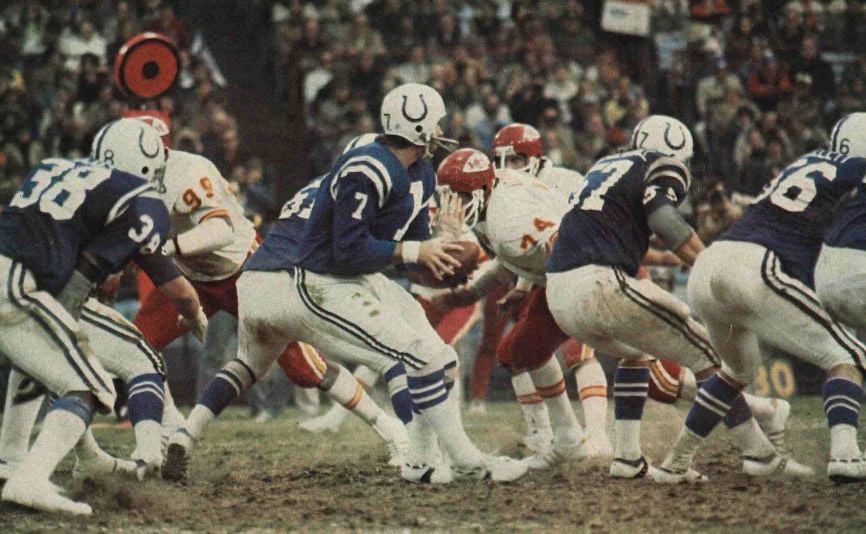
Bert: “Well, first of all, if ifs and buts were candy and nuts … we all know how that goes. But what’s important for me, I can honestly say to myself that I was the best player I could be. And – for a time – I was as good as there was in the league. Just because I didn’t always have the best luck with injuries or have the best team, that shouldn’t change what I thought my performance was. It was a great run. And I had a lot of fun with it.”
*******************************
He has been inducted into multiple halls of fame: The College Football Hall of Fame. The LSU Athletics Hall of Fame. The Louisiana Sports Hall of Fame. The Louisiana High School Sports Hall of Fame.
But Bert had never heard of something called the Hall of Very Good. Not until a plaque showed up one day in the mail at his lumber business. This was in July 2023.
The plaque was simple but eye-catching.
In black letters – all upper case: HALL OF VERY GOOD.
And below that: Bert Jones. Class of 2022.
A letter came with it.
The Professional Football Researchers Association is delighted to inform you that you have been elected to the PFRA’s Hall of Very Good … We established the Hall of Very Good in 2002 as a way to honor outstanding players and coaches who have not been inducted into the Pro Football Hall of Fame but nonetheless had outstanding careers that deserve to be recognized.
Bert wondered if this was even real. Was someone pranking him?
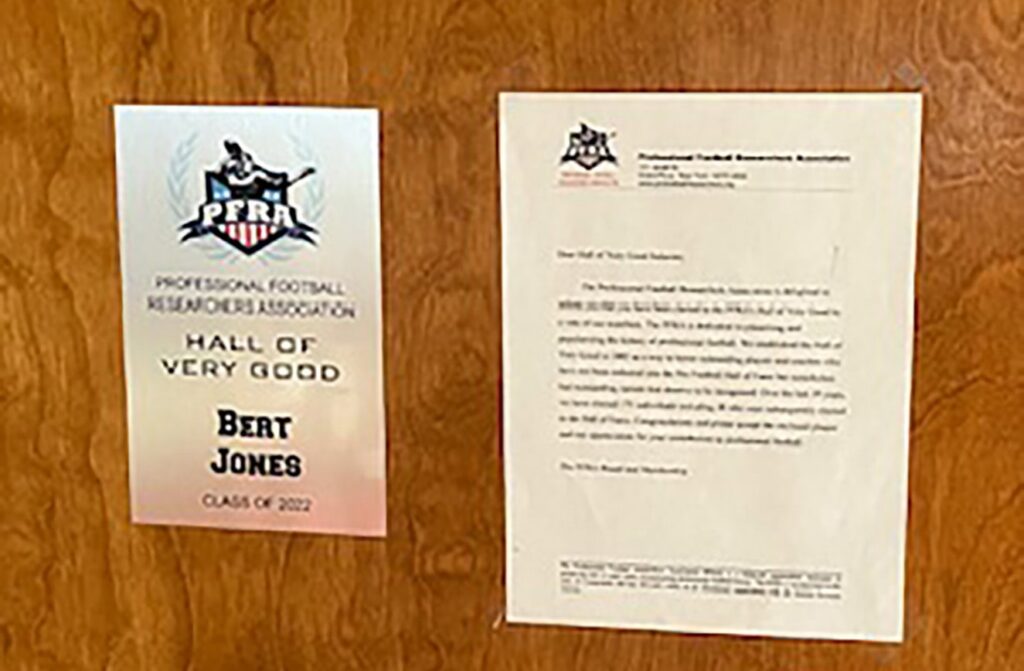
Legitimate or not, the plaque gave him joy – not because it puffed him up but because it amused him. So he posted it front and center on the wooden door to his office. Taped the letter up there, too. Both still greet him every morning.
The honor turned out to be real.
And Bert later learned that it actually placed him in lofty company. The Pro Football Hall of Fame has enshrined 36 quarterbacks. The Hall of Very Good includes 12 (one of whom – Ken Stabler – was first voted Very Good and then also elected into the Hall of Fame).
That makes Bert one of only 47 quarterbacks in the history of professional football granted permanent status in the top two tiers of recognition.
Impressive.
But he still gets playful jabs about his plaque. A recent one: “Guess it’s better than the Hall of So-So or the Hall of Better Than Nothing.”
Longtime Hall of Very Good voter Jim Saccomano – former public relations director of the Denver Broncos – is more serious-minded in his celebration of any player who makes it: “Every saint is not canonized, and every great player is not in the Hall of Fame.”
It’s a good point to be noted by any “history major” with fond memories of Bert and his playing days.
Previous stories:
Day 1: The Bert Jones I’ve always known: A personal tribute
Day 2: The real ‘original No. 7’ of LSU football
Day 3: The Ruston Rifle
Day 4: Football, family, and fun: A game weekend for the ages
Day 5: Bert Jones and Archie Manning: Always in friendship
Day 6: Power of the platform: Bert Jones took on a cause