With LSU football retiring the jersey No. 7 of Bert Jones on November 14, 2026, LouisianaSports.net is publishing a series about Jones called 7-on-7 … one story each day for seven days leading up to the jersey retirement ceremony.
The series is written by Pulitzer Prize winner Jeffrey Marx, author of six books including Walking with Tigers: A Collection of LSU Sports Stories.
For anyone into the history of LSU football, any mention of Bert Jones usually means a reverential retelling of the 1972 Ole Miss game is not far behind – and that is perfectly understandable.
It’s not every day that your quarterback drives your team down the field and – with 0:00 on the clock – calmly throws a come-from-behind touchdown pass to beat your arch rival and keep you undefeated after seven games.
That’s what Bert did on November 4, 1972. It was an instant classic. And it still ranks high on any list of legendary games played in Tiger Stadium.
People still talk about the clock management in that game. One: Bert handled the heart-pounding drama of the last possession – going 80 yards in three minutes and two seconds – with tremendous poise. Two: Did the LSU clock operator intentionally allow the Tigers extra time to run one last play?
Last-second theatrics notwithstanding, though, there was an entire game weekend the previous season that offered even more than the famous Ole Miss game: a wonderful combination of storylines – football, family, and fun – that was integral to the overall progression of Bert’s college career and also included an away-from-the-field window into who he really was.
The game itself was Notre Dame at LSU. November 20, 1971.
Bert was a junior. And this was his breakout game. It was the night that cemented his status as starting quarterback and launched him on a zoom climb to stardom.
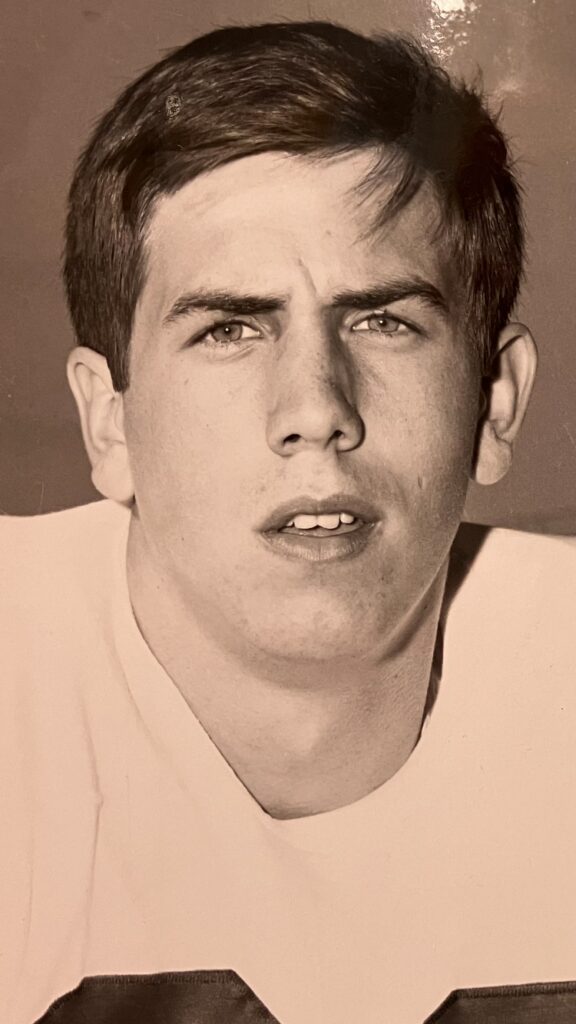
Bert and first-cousin Andy Hamilton – also his top receiver – turned the game into a family affair by scoring all four Tiger touchdowns.
LSU got its first-ever win over powerhouse Notre Dame.
And the triumphant quarterback had even made plans for some personal time in the woods – partaking in the opening weekend of deer season.
What could possibly be more Bert Jones than that?
What could possibly be better for a home-grown Louisiana boy than leading the LSU Tigers to a monumental Tiger Stadium victory on Saturday night and then – before the sun is even up – being in perfect position to start looking for deer?
As things turned out, Bert also needed flawless clock management to make all of this work. Different type of clock management this time. But it only made the story better.
*******************************
LSU and Notre Dame – two of the most prestigious programs in the country – had played each other only once before. It was the previous season at Notre Dame – and the No. 2 Fighting Irish escaped the defensive slugfest with a 3-0 win over the No. 6 Tigers.
It was a long trip back to Louisiana for LSU players and their fans. Now came the second part of the home-and-home series: the eagerly awaited rematch in Baton Rouge.
It was a chilly Saturday night – 56 degrees at kickoff and dropping – but clear and beautiful.
ABC-TV was broadcasting the game live across the nation well before coast-to-coast coverage was a regular feature of college sports.
No. 7 Notre Dame had lost only once in 1971 before facing No. 14 LSU. The Tigers entered the game with a disappointing 6-3 record but plenty of talent and a pent-up desire to get even.
It would not be easy. The Notre Dame defense was again one of the best in the nation. It had not allowed a single point in the second half of any of its nine games.
That only elevated the importance of a surprise decision by LSU coach Charles McClendon. All season, he had employed a two-quarterback system with Bert and Paul Lyons sharing the position. And Lyons had been the starter for all but the opening game.
Perhaps even ABC didn’t know what was coming. When it introduced LSU’s starters, both quarterbacks were asked to pose before a camera – one at a time – for a quick cameo. Lyons appeared first. Then Bert.
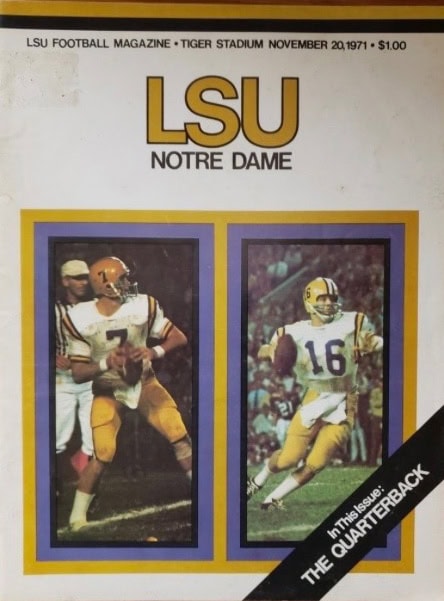
But that’s not how it went after LSU stopped Notre Dame on the first possession of the game and Coach Mac’s surprise was unveiled. As William F. Reed would later write in Sports Illustrated: “A murmur went through the crowd when junior Bert Jones trotted out to run the offense.”
The next significant responses were roars of delight, because Bert wasted little time before flashing his powerful arm and taking control of the game.
After only a single running play – and running was definitely LSU’s favored mode of transporting the ball throughout the McClendon era – Bert went straight to the air and connected with Hamilton for a gain of 36 yards down the right sideline.
Three plays later, they did it again. Another perfect pass and catch. Another 36-yarder on the right side of the field. Only this one ended up in the end zone. Touchdown! Five plays … 77 yards … LSU 7, Notre Dame 0.
The cousins were just getting started.
Instead of putting in Lyons for the next offensive series – which would have been consistent with Coach Mac’s usual policy of changing quarterbacks for each possession – he instead kept Bert in the game.
That second possession yielded no points. But it included another nice pass from Bert to Hamilton – this one completed over the middle for 17 yards.
Late in the second quarter – after LSU linebacker Warren Capone intercepted a pass and returned it to the Notre Dame 32-yard line – Bert went right back to the air on the first play. Another touchdown pass to Hamilton!
LSU 14, Notre Dame 0.
And that was how the first half ended.
Given the way college football has progressed through the years, it is hard to imagine an elite team throwing the ball only five times in an opening half. That was the number of passes Bert threw against Notre Dame before the break. (Lyons played only one series and did not throw a pass.)
All five of Bert’s passes were thrown to Hamilton. Four of them were completed. The cousins had already connected for 121 yards and two touchdowns.
*******************************
Their mothers were sisters.
Hamilton was born a year before Bert. They grew up near each other in Ruston, Louisiana. So they spent a lot of time together as kids – playing sports, hunting, fishing, sitting together in church – and they became friends in addition to relatives.
They even ended up looking like they could be brothers. As the LSU sports information office once put it in a feature story: “They stand side-by-side and the resemblance is startling.”
The cousins also shared a commitment to hard work. Starting in high school, they had their own summer practice sessions, morning and afternoon, just the two of them and a football on the field at Ruston High.
“We threw hundreds of balls in the hot Louisiana sun,” Hamilton says. “I don’t know, maybe 200, 300 passes a day. I could run all day and Bert could throw all day.”
Hamilton was always amazed at what Bert could do with a football: “He had such big hands, a big arm, and he could toy with that ball like he was throwing a tennis ball. The ball he threw was such a tight spiral. And he could throw it about as far as he wanted to.”
Bert always admired what Hamilton could do as a receiver: “Really good moves. And he had the best hands ever. Fabulous hands. Better hands than anybody I ever played with.”
All those hours together made the duo unmistakably greater than the sum of its parts.
“We developed kind of a sixth sense,” Hamilton says. “Bert knew when and where I’d break on my route. And he knew how to get the football to me.”
In one game for the Ruston Bearcats, Hamilton caught 14 passes from Bert for a total of 220 yards – crazy numbers for a late-1960s high school game when running the football was still the primary focus of most offenses.
When he arrived at LSU, Hamilton was asked to fill out a questionnaire routinely given to new members of the football team. One of the questions was: “What do you like most about football?” His answer: “The passing game.”
Bert was later asked the same question, and he wrote only two words: “Playing, winning.”
Together, the cousins were now getting to do everything they liked most about their favorite sport – and with a packed crowd of 66,996 fired-up fans eager to see more in the second half at Tiger Stadium.
*******************************
Late in the third quarter, Bert ran six yards off left tackle for a touchdown of his own. After being knocked to the ground, he popped right up and lifted the ball toward the night sky – his raised right arm an exclamation point as Tiger Stadium went wild.
“Pandemonium has broken loose among the Tiger fans and players,” radio announcer John Ferguson said on the LSU football network.
So much for Notre Dame’s season-long streak of not giving up any second-half points. After the extra point, LSU led 21-0.
Notre Dame avoided a shutout by scoring late in the fourth quarter.
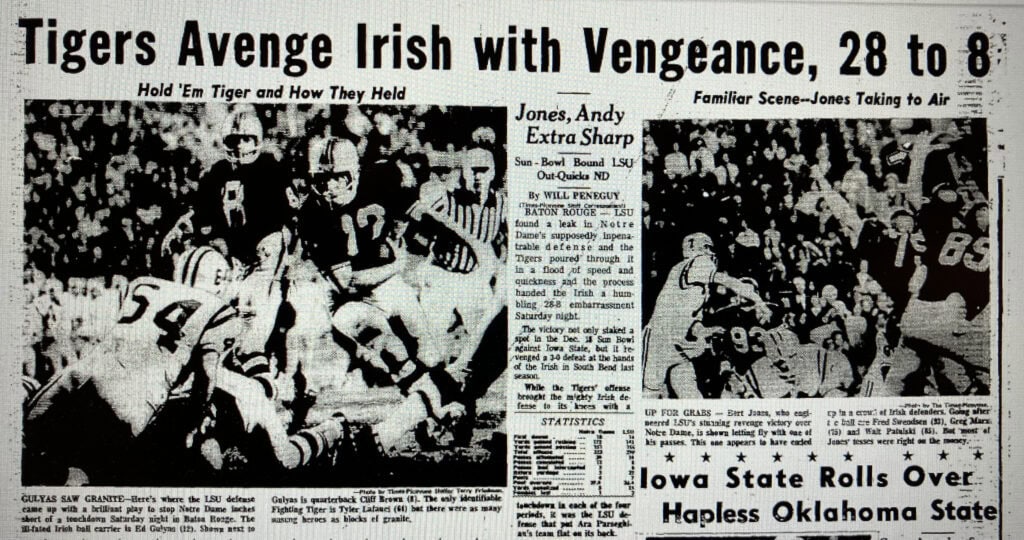
And – with 25 seconds remaining – Hamilton answered with a final touchdown of his own. This one came on a 13-yard pass from Paul Lyons. Hamilton and Bert had scored all four LSU touchdowns – one each quarter – to defeat the Fighting Irish 28-8.
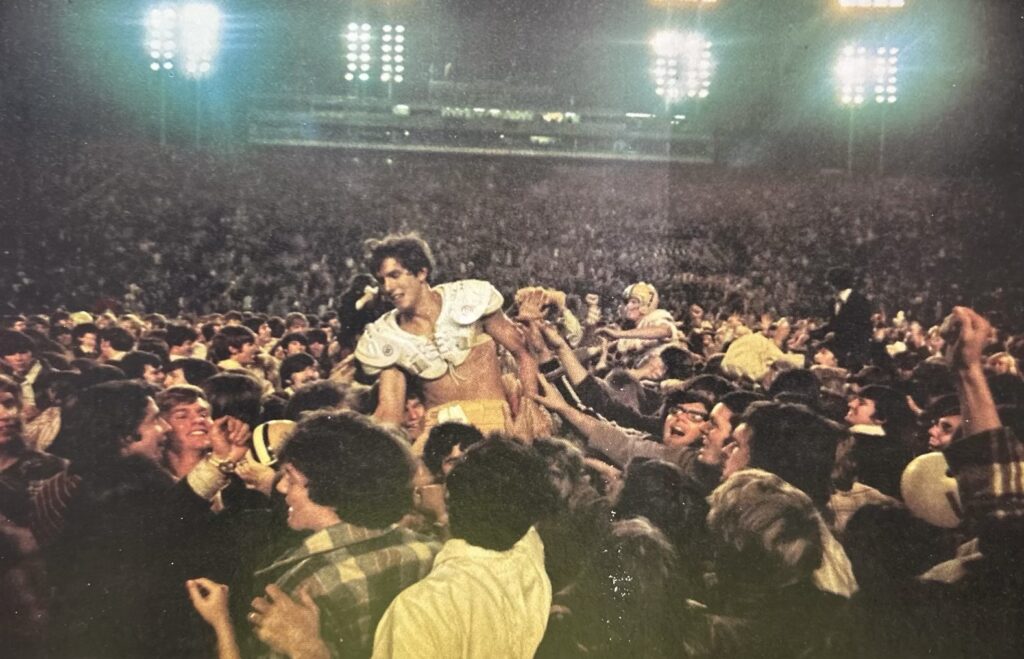
Thousands of fans stormed the field – sooner than they should have – and the game had to be called with one second still on the clock.
Bert and Hamilton were right in the middle of all the madness. They were lifted and carried. Fans tore away their jerseys and left them wearing only shoulder pads.
The goal posts did not fare well, either.
All of which was fine with Coach Mac. After he escaped to the safety of the locker room, his summary assessment was no more restrained than the frenzy outside: “I’ve been at LSU nineteen years and this was the greatest victory in Tiger Stadium in that time. How sweet it is!”
*******************************
The LSU defense – featuring Tommy Casanova in the secondary, Warren Capone at linebacker, and Ronnie Estay on the line – had been phenomenal.
But the Ruston cousins were clearly the players of the game.
Bert completed seven of nine passes for 143 yards and two touchdowns to go with that one of his own on the ground.
Hamilton had seven catches for 153 yards and three touchdowns (tying the LSU record for touchdown receptions in a game).
Bert and his family had already been well acquainted with Tiger Stadium. His father Dub had played for LSU before a successful NFL career with the Cleveland Browns. Dub’s brother Carroll had also played for the Tigers. And Bert’s brother Ben was now on the LSU freshman team.
Never before, though, had the family left such an extraordinary mark on a single night.
Bert was thrilled that his father was there to see it.
Dub even had an extra treat. He got to see an old friend. Notre Dame coach Ara Parseghian – who had already won a national championship in 1966 and would win another in 1973 – was one of Dub’s old teammates with the Browns. They had always stayed in touch.
“So … fair to say that was a special night for Daddy,” Bert says.
There would be plenty more to come.
McClendon would continue his dual-quarterback system. But Bert would be the permanent starter for the rest of his time at LSU.
Hamilton ended up breaking LSU receiving records in almost all major categories. Among them: Catches in a season (45) and in a career (100). Receiving yards in a game (165) and a season (870) and a career (1,995). His total of 24 touchdowns – receiving and rushing combined – tied Billy Cannon’s LSU record for most in a career.
Bert, too, pretty much rewrote the LSU record book in major categories related to his position. Among them: Passing yards in a game (242) and a season (1,446) and a career (3,255). Touchdown passes in a season (14) and a career (28). His senior year of 1972, Bert would be named first-team All-American and finish fourth in Heisman Trophy voting.
For the moment, though, Bert was not even thinking about football. He had another pressing matter on his mind.
*******************************
Fans storming the Tiger Stadium field was not the closing act of the weekend. For Bert, the final drama came in the secluded woods of little Tensas Parish in northeastern Louisiana – and on the roadways back to Baton Rouge. All because he was adamantly opposed to missing out on the first weekend of deer season.
A hunter wanted to hunt. Needed to hunt. Bert needed some time in the woods.
“Perfect place to be after all the craziness of a big game in Tiger Stadium,” Bert says. “Perfect place to be pretty much any morning.”
The plan was set in the days leading up to the Notre Dame game. A Kappa Sigma fraternity brother and friend, Brian Campbell, had invited Bert to join him for a hunt on old family property. Sunday was always a day off for the football team, so Bert was an immediate yes, and then a few teammates, including Hamilton and Tommy Casanova, were also asked to go. A grand time would be had by all.
But then Coach McClendon did something he had never before done – at least not while Bert was at LSU. In the locker room after the game, Coach Mac called a team meeting for Sunday afternoon.
So much for hunting.
But wait …
Bert was still determined to go.
His teammates backed out – not wanting to risk the chance of being late or altogether missing the meeting if they were somehow delayed returning to campus.
“But I was not missing out on this,” Bert says. “I was going.”
As Hamilton puts it: “Nobody but Bert had the guts to do that.”
Bert also had everything timed out.
Brian Campbell picked him up in front of Broussard Hall at 3:00 in the morning – mere hours after Bert had been carried off the field. They reached the woods by dawn, and Campbell’s older brother, Richard, met them there. The hunting dogs were already in place and eager for action.
The three hunters sat on stumps in separate areas – all knowing they needed to be out of the woods by exactly 11:00 for Bert to make it back to LSU in time for the meeting.
Nobody saw a deer all morning. Then – with only a few minutes left – a beautiful 8-point buck appeared straight in front of Bert. He could hardly believe it. And that was the end of the buck.
By plan, the Campbell brothers were already on their way to pick up Bert. “And by the time we got to him, there he was with that buck,” Brian Campbell says. “We put the deer in my brother’s truck – left it with him – and then we hightailed it back to Baton Rouge.”
Bert arrived just in time for the meeting. Clock management.
He still loves that story. Still can’t tell it without laughing about taking his chances against the clock – risking the potential wrath of his coach in return for a morning in the woods.
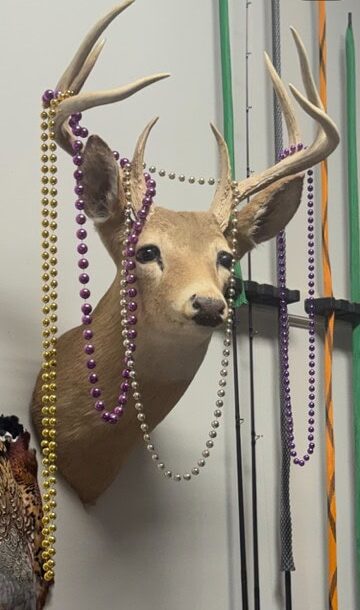
Bert long ago gave that deer a name: The Notre Dame Buck. It is mounted and still hangs on a wall in a large closet – home to Bert’s hunting and fishing equipment – out by his carport. Mardi Gras beads, most notably a few shiny purple and gold strands, decorate the antlers.
Forever silent, that buck nonetheless tells an LSU football story for the ages.
A surprise starter at quarterback leads his team to the school’s first win over one of the most decorated and celebrated football programs in the country. Chaos ensues as fans party on the field. The quarterback gets only a few hours of sleep and then goes from one passion to another – from the public rush of throwing touchdown passes on national TV to the private contentment of sitting alone on a stump for the start of deer season.
What a weekend.
Previous stories:
Day 1: The Bert Jones I’ve always known: A personal tribute
Day 2: The real ‘original No. 7’ of LSU football
Day 3: The Ruston Rifle