
LSU Athletics
By Hunt Palmer
The new Tiger bats didn’t stand up to SEC pitching. That’s true.
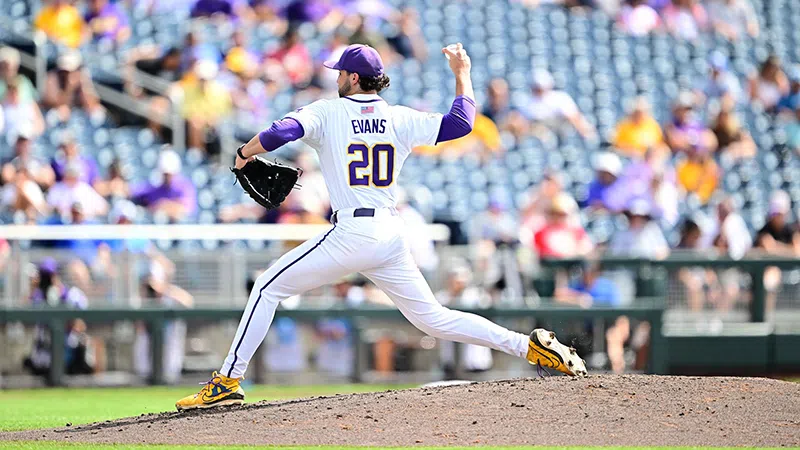
What’s also true is that LSU went from the best one-two punch in school history to a well below-average SEC rotation. Casan Evans was masterful against Oklahoma and wasn’t really in any other SEC game. William Schmidt was great against Kentucky and South Carolina. He wasn’t really in any other SEC game. Those three offenses ranked in the bottom five in the SEC in scoring runs.
Cooper Moore only made one full SEC start. He gave up four earned runs on seven hits in four innings at Vanderbilt. Moore did throw a ton of early strikes through six weeks. He racked up strikeouts on Milwaukee and Northeastern, both of which made the NCAA Tournament. But the sample size is very small.
Marcos Paz pitched to a 9.20 ERA and walked 27 in 29.1 innings. He did flash a 96 mph fastball and sharp breaking stuff in his first action back from Tommy John surgery. He’s a long way from a lost cause, but he was also a long way from a reliable SEC starter.
STARTING PITCHING
WHO IS GONE?
WHO CAN RETURN?
Casan Evans, William Schmidt, Cooper Moore, Marcos Paz, Reagan Ricken
THE OUTLOOK
Evans proved as a freshman he can handle SEC offenses. He threw 31.1 innings against league teams, largely in a relief role, and pitched to a 2.30 ERA with 34 strikeouts and 13 walks. Working the last three innings of a tight game isn’t exactly like working the first six week after week, but it’s also not like Tuesday against Nicholls. He just regressed with his command this season.
Schmidt undoubtedly made strides from the freshman who walked 11 SEC hitters in two innings. He was a capable SEC starter whose statistical profile fit a Sunday guy who was going to give you four innings. And that’s the role he started the season in. As the first two went down, he was bumped to Friday, and his stats don’t add up there. He worked into the seventh once this season, and that was against Dartmouth.
Moore proved himself to be a strike thrower. He was that at Kansas, too. The fastball is not overpowering, but it does sink. I liked a lot of what I saw from Moore early on, but the competition level was very poor.
Paz was put in a tough spot. By the time the starting job on the weekends was his, Mississippi State, Georgia and Florida were on the schedule. That’s about as brutal as it gets. He did handle his business against a putrid Gamecock offense.
I added Ricken in here based purely on profile. He’s 6-foot-5, an excellent athlete, and he has the smoothest delivery among this entire group. He never looks like he’s maxing out, and he still has 94 in the tank as a true freshman who spent most of his high school days playing quarterback. His breaking ball also has a tight shape. This is a project for Nate Yeskie and Jamie Tutko, but it’s an intriguing one.
OVERVIEW
Simply, LSU has to add on.
Many years, returning your top four options is a great thing. In this case, it’s a load of talent but not a group you can stand pat with. LSU didn’t need to add outfielders last summer with Chris Stanfield, Derek Curiel and Jake Brown returning. This is not like that.
Asking a bunch of 5.00-plus ERAs to come back and pitch at a championship level is not a high-percentage play.
I’ll toss you a few high-profile names that most LSU fans will remember as examples of the types of arms LSU needs to acquire this summer.
- Joey Volchko (Stanford) and Dylan Vigue (Michigan) hopped into Georgia’s weekend rotation and pitched like a true one-two this year.
- Tomas Valincius came over from Virginia and pitched like an ace at Mississippi State.
- Jake Marciano was at Virginia Tech. He became Auburn’s ace and helped end LSU’s season last week.
- Jaxon Jelkin dominated LSU while at Kentucky this season. He came from Houston.
- Hursten Waldrep went from Southern Miss to Florida. LSU saw him in the NCAA Tournament in both places in 2022 and 2023.
- Zach Root from East Carolina to Arkansas. LSU beat him in Omaha, but he had torched Tennessee in the Super a week earlier.
- That’s not to mention Gage Jump, Luke Holman and Anthony Eyanson. I’ll leave Paul Skenes out.
These arms are available every year in some form or fashion. LSU has to land a Friday night guy at a minimum. That reshuffles the roles of the returners and may put them in a more favorable spot. Preferably, LSU lands two big time starters and then creates a ton of competition where only one or two returners have to take a leap forward.
I know it’s not what either wants in his draft year, but I can really see Evans or Schmidt in a relief role being very effective. Evans has already done it, and Schmidt’s 97 mph fastball and wicked curveball for six outs instead of six innings is really intriguing.
I’m not at all closing the book on those two. They just didn’t have great years. At LSU, things are expected to be great across the board. LSU’s offense was awful against Oklahoma and Texas A&M. The defense ranked at the bottom of the SEC all year. They made baserunning errors week after week and blew some leads, too. Evans and Schmidt weren’t responsible for any of that.
They were responsible for way too many walks, wild pitches and earned runs allowed.
This is where I’m really, really going to reach. If somehow LSU could land two front end starters and move Moore to a four-inning midweek starter, that would be such a valuable thing for the postseason. Now, LSU hasn’t had three good starters since 2017, so asking for four is really overdoing things. That’s said, it’s fair to dream in June.
Jay Johnson once again proved that his offense will figure some things out year over year. This one was held together by scotch tape and band-aids and proved pretty good late in the season. Pitching has to be priority No. 1 this offseason. Whatever LSU’s budget totals, a strong portion of that needs to be focused on arms.


More LSU Stories