As America celebrates its 250th birthday on Saturday, it’s a fitting time to remember that while the SEC’s history isn’t nearly as long, the conference has produced more than legendary athletes. Throughout its history, the league has been home to men whose legacies extend far beyond the playing field and onto the battlefield through remarkable service, leadership and sacrifice.
Shug Jordan, Auburn
There may not be a more fascinating story in the history of the league than the one of legendary Auburn head coach, Ralph “Shug” Jordan.
Jordan lettered in football, basketball and baseball at Auburn before graduating in 1932. He immediately entered the coaching profession, taking over as Auburn’s head basketball coach, a position he held for 10 seasons from 1933 through 1942.
That career was put on hold in 1942 when he joined the US Army during WWII. As an officer, he took part in four major invasions, including D-Day, when he stormed the beaches of Normandy and later received a Purple Heart and Bronze Star. Even after being wounded, he continued to serve and later fought in Okinawa.
When he returned home from war he left Auburn for Athens and became the head basketball coach and assistant football coach at Georgia from 1946 until 1950. He finally returned back to Auburn as the head coach of the Tigers in 1951 and led Auburn to a national championship in 1957. He remained as the head coach from 1951-1975.
How cool was Jordan? He stormed the beaches at Normandy, has the fifth most wins in Auburn basketball history (95), recorded the most wins of any football coach in the program history (176), and if that wasn’t enough, had the stadium named after him in 1973 while he was still the head coach. What a resume.
Robert Neyland, Tennessee
Neyland won at everything he did, and was a swiss army knife of manhood and professional significance.
He served as the head coach at Tennessee in three separate stints. He won 173 games as the head coach and had a win percentage of over .800. Neyland’s teams finished with six undefeated seasons, seven conference championships and four national championships.
He was an innovator whose influence extended beyond the field. He is widely credited as one of the first coaches to use sideline telephones to communicate with the press box and to incorporate game film as a regular coaching and evaluation tool.
Neyland was a defensive mastermind. Remarkably, 112 of his 173 career victories, nearly 65 percent, came by way of a shutout. His 1939 team also remains the last program in college football history to complete a regular season without surrendering a single point.
That was on the field. Off the field he was even more impressive.
Neyland’s first tenure as Tennessee’s head coach spanned from 1926 to 1934, a remarkable stretch during which the Volunteers lost just two games over his first seven seasons. His coaching career was briefly interrupted by active military service in Panama before he returned to Knoxville from 1936 to 1940, posting a 31-2 record over his final three seasons. In 1941, World War II called him back into military service for the second time in his life. He was awarded the Distinguished Service Medal and ultimately retired with the rank of brigadier general.
Neyland’s career was as awe-inspiring as it was jaw dropping. He attended West Point, played football, threw the academy’s first no-hitter in baseball and won a school boxing championship. He turned down an opportunity to play for the New York Giants in order to serve in World War I, then returned home and earned a graduate degree in engineering from MIT. By just 34 years old, and with only one year of coaching experience, he was named Tennessee’s head coach and athletic director.
Ken Kavanaugh, LSU
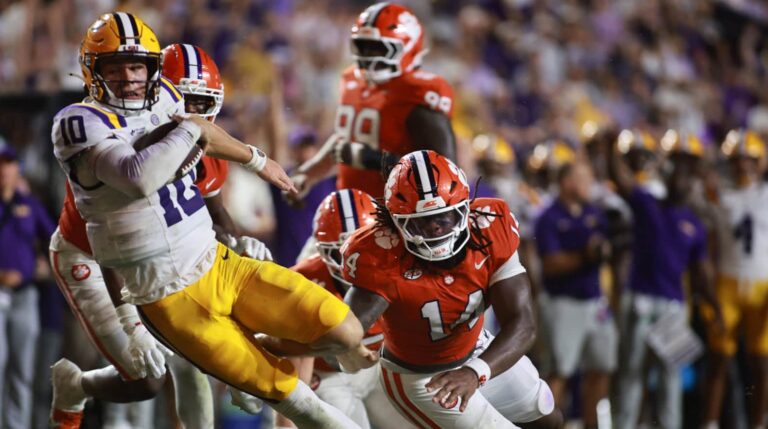
Kavanaugh was a wide receiver for LSU from 1936 until 1939. He led LSU in receptions, receiving yards and touchdowns for three straight years and was named the Co-Player of the Year in the SEC in 1939. That year, he finished seventh in the Heisman Trophy voting and won the Knute Rockne Memorial Trophy as the nation’s top lineman.
After he finished playing in Baton Rouge, he signed a contract with both the St. Louis Cardinals and Chicago Bears to play professional baseball and football. He won the NFL Championship with the Bears in his first two seasons, scoring a touchdown in each of the championship games.
His football career came to an abrupt halt when he left Chicago to serve as an Air Force captain during World War II. He flew 30 combat missions, including alongside his former college and professional quarterback, Young Bussey, who was killed in action. For his service, Kavanaugh was awarded both the Air Medal and the Distinguished Flying Cross..
He returned from war and played five more seasons for the Bears. He won another NFL Championship in 1946 and was named to the All-NFL team for three consecutive seasons from 1946 to 1948.
He still holds the franchise record with 50 career receiving touchdowns. After his playing career, he transitioned into coaching, serving on the staffs of the Bears, Boston College and Villanova. He wrapped up his coaching career in 1971 after serving as the Bears’ offensive coordinator, then spent the next 28 years as a scout for the organization before retiring in 1999. He died eight years later in 2007.