The New Orleans Saints appeared to have a successful draft process again this year. The Saints loaded up with eight selections, including three wide receivers for the first time since 1989, and a key trade addition
With all of their new acquisitions in place, rookie minicamp will become the team’s first opportunity to place their draft picks in the areas they’re expected to contribute in the football field. Meanwhile, edge rusher Tyree Wilson will see his role come to fruition beginning with OTAs.
In order to prepare, here are the projected roles each player is likely to start working in, the needs they fill and what else could be on the horizon for them.
Round 1, Pick 8: Arizona State WR Jordyn Tyson
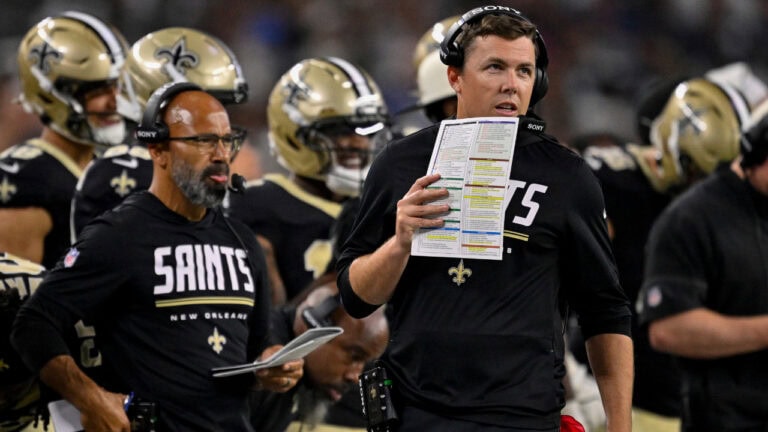
Initial Role: Because head coach Kellen Moore moves his receivers all around the formation, resisting the temptation to call Tyson the X-receiver is challenging but necessary. Instead, he’ll share the tag of primary wideout alongside Chris Olave. The two will move about the formation, taking snaps interchangeably along with Devaughn Vele at X, Z, in the slot and elsewhere.
Need Filled: Tyson gives the Saints another top receiving option and a new best friend to quarterback Tyler Shough on the field. He provides another winner at the position.
On The Horizon: Greatness. Tyson can easily be the best receiver of his class and become one of the best in the league. Health and availability will always be the question, but the nature of his injury and lack of long-term concern indicators are about as promising as his projected ceiling.
“Jordyn’s a really exciting player for us,” Moore said. “Managed to play a ton of positions. His versatility, the way he attacks the football, the way he catches the football, the way he can separate at the line of scrimmage, at the catch point. A lot of positives with this one, and so we’re fired up.”
Round 2, Pick 42: Georgia DT Christen Miller
Initial Role: Miller likely immediately slots into the rotation as an early-down defensive tackle to help support the Saints’ run defense. His 6-foot-3 and 321 pound frame and active, violent hands are going to be important assets for his ability to contribute at nose tackle.
Need Filled: Though the Saints’ run defense improved last year, the unit still has a ways to go. New Orleans finished as the No. 19 run defense in 2025, up from No. 31 in 2024. But that leap shouldn’t be taken as a completed job.
On The Horizon: Miller’s 11.3% pass rush win rate is among the upper percentile of his defensive tackle class. While he’s often referred to as a run-stopper, he has some untapped potential in the pass rush. He’s also got the versatility to move around and play more roles than just nose tackle.
“I think one of the things that Christen has done is he’s played a number of spots across the front,” Moore said. “And I think that versatility is going to provide you with some fun chess piece games.”
Round 3, Pick 73: Georgia TE Oscar Delp
Initial Role: True-Y, in-line tight end. Delp gives the Saints a player that can immediately slot in and improve the room by giving it talent it doesn’t currently have at a high level. The Saints have some premier pass-catchers at the position in tight ends Juwan Johnson and Noah Fant. Delp gives New Orleans a proven blocker at the position to help support the run game.
Need Filled: This will encompass both the present and future for the Georgia Bulldogs tight end. Immediately, he gives the Saints an in-line presence with pass-catching athleticism. As he develops, he has the potential to become the top tight end for the Saints’ future.
On The Horizon: Just like Miller, his college teammate, Delp will fit an immediate profile of assisting in the run game (except on offense) but brings potential to do much more. Delp’s 4.49 speed and impressive athleticism will lead to heavier usage and production as a pass-catcher in the pros.
“He’s a multi-spot guy,” said Moore. “He’s played a lot of different positions in his career (at Georgia). He’s played with some other tight ends and he knows how to play that multi-tight end type role.”
Round 4, Pick 132: Auburn G Jeremiah Wright
Initial Role: Depth at guard. Wright grew up playing tackle and then moved to the defensive line. He moved to the offensive interior while at Auburn and has shown a ton of promise since. However, he’s arrived at a spot that will give him a chance to develop and provide quality and competitive depth in the meanwhile.
Need Filled: New Orleans can use all the help it can get when it comes to depth on the offensive line. The unit, as is the case for most NFL teams, doesn’t often stay healthy across all five spots. Having talent ready to spell starting players is wildly valuable.
On The Horizon: Wright had the potential to be a starter during his rookie contract. The Saints appear to be far from enamoured with right guard Cesar Ruiz, who was once the subject of trade rumors, as he enters the penultimate year of his contract and final year with base salary guarantees. If Wright develops as expected, he could be tasked with sliding into that role.
“Big people-mover,” general manager Mickey L said of Wright. “He’s gonna come in and immediately add size and power to our offensive line. We’ll see how he develops.”
Round 4, Pick 136: NDSU WR Bryce Lance
Initial Role: Rotational deep threat. The top of the wide receiver chart is currently set, but Lance will still see opportunities. Whether due to injury or rotation, his 4.34 speed and 6-foot-3, 200-plus pound frame can complement any receivers he takes the field alongside.
Need Filled: Even with Tyson selected in the first round, the Saints were still slim with proven talent at wideout. Lance adds a productive and unique presence. He had back-to-back 1,000-yard receiving seasons and contributed 25 career receiving touchdowns at NDSU.
On The Horizon: Vele is entering both the final year of his contract and his age 28 season. Should he not re-sign or be extended following his contract expiration, Lance appears to have a similar skill set to step into a larger role beside Olave and Tyson.
“We’re adding a developmental 6-3, [4.3] player that didn’t play at power before conference,” Loomis said. “He played for North Dakota State. So there’s probably some development that we need to do there.”
Round 5, Pick 150: traded to Las Vegas Raiders for EDGE Tyree Wilson
Initial Role: Rotational edge rusher. Wilson, a former No. 7 overall pick, doesn’t have to arrive in New Orleans as a hero of a pass rusher. He just needs to provide rotational contributions along with defensive end Carl Granderson, complementing Chase Young.
Need Filled: New Orleans primarily rotated four defensive ends last year. Young, Granderson, Cameron Jordan and Chris Rumph II. Jordan presently remains a free agent. Wilson can immediately step into his snap share unless Jordan ends up returning, which could then push Rumph out of the rotation.
On The Horizon: If Wilson does even 80% of what Young did upon arriving in New Orleans, he could find a new long-term opportunity as one of the team’s top pass rushers and edge setters. Wilson only turns 26-years-old in May.
“I think we’ve got a couple of different ideas [on] how to use him,” Loomis said of Wilson.”We’ll see in this offseason and training camp if that comes to fruition.”
Round 5, Pick 172: Ohio State S Lorenzo Styles Jr.
Initial Role: Return ace and defensive back depth. Styles returned the first Ohio State kick return for a touchdown in 15 years last year. Every NFL team now has to have two returners back for kickoffs. Styles could very well be one of them with his 4.27-second speed. It wouldn’t be surprising to see him contribute as a gunner or coverage player on special teams as well.
Need Filled: Styles adds more speed to the defense and special teams while providing depth among the defensive backs.
On The Horizon: Styles’ speed and physicality could put him in line for consideration in the slot. He’ll have to continue to develop his play on defense, but the former wide receiver has a lot of desirable traits to lean on.
One of the key stories to watch with Styles will be recovery from offseason labrum surgery. So far, all projections are positive.
“I don’t know that we expect him to be ready at the beginning of training camp, but certainly during the course of training camp,” Loomis said. “We’re really well aware of his timeline and feel pretty good about it.”
Round 6, Pick 190: LSU WR Barion Brown
Initial Role: Another return ace. As aforementioned, teams need two kick returners lined up at every kickoff, Brown will be one of them. The Saints landed one of college football’s best return talents.
Need Filled: After trading away wide receiver and return specialist Rashid Shaheed last season, the Saints shuffled a number of returners with varying levels of success. Brown should immediately walk into the facility on Airline Drive as the best option on the roster to take that mantle.
On The Horizon: Brown can also stretch the field on offense. As a returner, he’s likely to make the active roster through a special teams path. However, his speed, movement ability and fearlessness can open some opportunities for him to contribute as a deep threat and yards after catch producer on offense.
“You always want to add speed to your team,” Loomis said of the speed added with this draft class. “With us, Rashid last year, that’s a big element of his game. And so we wanted to add that, we wanted to add some return ability. We got that, so it was conscious.”
Round 7, Pick 219: Iowa CB TJ Hall
Initial Role: Defensive back depth. Hall still has some development ahead of him, stepping into his larger roles at Iowa just two seasons ago. His tackling ability (5.4% missed tackle rate in 2025) and high football IQ provide a strong foundation upon which to build.
Need Filled: Hall gives the Saints more depth in the secondary including more competition in the slot. Not only does the team need a starter there, but will be in need of insurance policies as well.
On The Horizon: Every seventh-round pick has a long road ahead of them, Hall is no exception. But if he develops well and continues his high-level of processing and physicality, he can carve out a path to key depth at worst.
“Played at Iowa, played at a high level,” said Loomis. “That’s a really good program. He’s well coached, and it’s a guy we can throw in at a couple positions, because we think he’s a pretty versatile athlete and we might have a swing in three different spots for him.”